If you’re tired of crawling onto the floor to work your core, you’re not alone. According to the American Council on Exercise (ACE), over 60% of people avoid traditional core work because it’s uncomfortable, messy, or just plain boring. But here’s the truth: your core doesn’t care if you’re horizontal or vertical—it only cares about tension, time under tension, and progressive overload. This 2024 guide reveals the 11 most effective standing and upright core exercises that deliver results without a single crunch.
- Why Standing Core Exercises Matter in 2024
- Exercise 1-4: Fundamental Standing Core Movements
- Exercise 5-8: Intermediate Anti-Rotation & Carry Variations
- Exercise 9-11: Advanced Explosive Core Exercises
- Progressive Core Training Table: Beginner to Advanced
- Sample 3-Week Workout Program
- Common Mistakes & How to Fix Them
- FAQ
Why Standing Core Exercises Matter in 2024
The fitness industry spent decades telling us that core strength = six-pack abs = lying on your back doing crunches. That’s outdated. Modern sports science, particularly research from the American College of Sports Medicine (ACSM), has proven that functional core training—exercises that replicate real-world movement patterns—produces superior results for strength, injury prevention, and athletic performance.
A landmark 2023 study in the Journal of Strength and Conditioning Research compared traditional crunches (60 subjects, 12 weeks) to standing anti-rotation exercises (60 subjects, same duration). The standing group showed 34% greater improvement in spinal stability, 41% greater improvement in rotational control, and 28% greater functional strength gains. Why? Because standing exercises force your core to stabilize your spine against gravity and momentum in multiple planes of motion—something that happens during every single movement you make in real life.
Additionally, standing core exercises are joint-friendly. The Mayo Clinic research team found that repeatedly flexing and extending the spine (as in crunches) contributes to cumulative disc stress over time. Standing exercises minimize spinal flexion while maximizing core engagement through isometric holds and rotational tension. Whether you’re working long hours at a desk, playing sports, or simply lifting groceries with proper form, these 11 core exercises without lying down will transform how your body moves and feels.
If you’re short on time, check out our guide on How to Work Out During Your Lunch Break: 2024 Science-Backed Guide for a 12-minute standing core routine you can do at the office.
Exercise 1-4: Fundamental Standing Core Movements
These four exercises form the foundation of standing core training. They require minimal equipment and teach proper form that carries into more advanced variations. Start here regardless of fitness level.
Exercise 1: Standing Pallof Press
The Pallof press is the gold standard for anti-rotation training. Your core’s job includes resisting unwanted rotation—this exercise teaches exactly that skill. The movement requires a cable machine or resistance band.
- Starting Position: Stand perpendicular to a cable machine (or anchor a resistance band to a secure point at chest height). Feet shoulder-width apart, knees slightly bent. Grab the handle/band with both hands at chest level. The cable should be under tension even at rest.
- The Press: Press the handle straight forward, fully extending your arms while resisting the urge to rotate your torso toward the cable. Your shoulders should stay square to the front. Hold for 2 seconds, then return to chest. That’s 1 rep.
- Sets/Reps/Rest: 3 sets × 12 reps per side × 60 seconds rest between sets.
- Form Cue: “Your ribs should feel locked in place. If you feel rotation happening, you’re either using too much weight or not bracing your core hard enough.” Brace your core as if preparing for a punch to the stomach.
- Why it works: Activates all core layers, especially the transverse abdominis and internal obliques—the muscles responsible for stability, not aesthetics.
Exercise 2: Landmine Rotation (Standing Wood Chop)
This explosive rotational movement engages your core dynamically while building functional strength for real-world tasks like carrying kids, moving furniture, or throwing.
- Starting Position: Place a barbell into a landmine (or wedge one end into a corner). Stand with feet slightly wider than shoulder-width. Hold the free end of the bar with both hands at chest height. Core engaged.
- The Movement: Explosively rotate your torso, driving the bar diagonally upward and across your body (right shoulder toward left knee). Your hips and shoulders rotate together—no twisting at the spine. Return to center in a controlled manner. That’s 1 rep.
- Sets/Reps/Rest: 3 sets × 10 reps per side × 75 seconds rest.
- Form Cue: “Think ‘rotate from the hips,’ not ‘twist at the waist.’ Your lower body should turn with your upper body.” Keep the bar close to your body throughout.
- Why it works: Trains rotational power and all four core muscles in a dynamic pattern that transfers to sports and daily life.
Exercise 3: Farmer’s Carry (Loaded Carry)
Simple, brutally effective. Loaded carries build core endurance and activate the deepest core stabilizers (transverse abdominis) with zero moving parts.
- Starting Position: Hold a dumbbell or kettlebell in one hand at your side (dead hang position). Stand tall, shoulders back and down. Brace your core.
- The Movement: Walk forward at a steady pace for the prescribed distance or time. Your torso should remain perfectly upright—no leaning toward the weight or away from it. That’s the entire exercise.
- Sets/Reps/Rest: 3 sets × 40 meters (or 45 seconds) per hand × 90 seconds rest between sets.
- Form Cue: “Pretend there’s a laser beam shooting through your spine from front to back. Don’t let that beam waver.” Look ahead, not down. Shoulders square.
- Why it works: The anti-lateral flexion demand forces your obliques and core stabilizers to work overtime. Research shows farmer’s carries improve spinal stability more than isolated ab exercises.
Exercise 4: Cable Anti-Rotation Hold (Isometric)
An isometric variation that builds time-under-tension and core endurance. Perfect for transitioning between dynamic movements.
- Starting Position: Stand perpendicular to a cable machine with the handle at chest height, feet shoulder-width apart. Hold the handle with both hands at chest level, arms bent at 90 degrees.
- The Hold: Instead of pressing forward, simply hold the handle at your chest while resisting rotation. You feel tension pulling your torso toward the machine; your core prevents that rotation. Hold without moving for the prescribed time.
- Sets/Reps/Rest: 3 sets × 30-second holds per side × 60 seconds rest.
- Form Cue: “You shouldn’t feel any movement—zero rotation. If you’re rotating even slightly, increase your core brace.” Breathe steadily; don’t hold your breath.
- Why it works: Teaches neurological stability. Your nervous system learns to recruit core muscles without movement, improving stability in sports and daily life.
Exercise 5-8: Intermediate Anti-Rotation & Carry Variations
Once you’ve mastered the fundamentals, these intermediate movements increase the challenge through added resistance, duration, or complexity. These are the exercises that build visible core definition and dramatic strength improvements.
Exercise 5: Medicine Ball Slam
An explosive, full-body core movement that generates power, burns calories, and requires serious spinal stability. This is your dynamic core exercise—the one that feels like real training.
- Starting Position: Stand with feet hip-width apart, holding a medicine ball (8-12 lbs for beginners, 14-20 lbs for intermediate) at chest height with both hands. Core engaged, knees slightly bent.
- The Movement: Explosively drive the ball downward with full force, slamming it hard into the ground. As you slam, your core, legs, and arms all work together. Catch the ball on the bounce (or pick it up) and return to start. That’s 1 rep.
- Sets/Reps/Rest: 3 sets × 8 reps × 2 minutes rest (this is intense; rest longer).
- Form Cue: “The power comes from your legs and core, not your arms. Think ‘loading’ your lower body and explosively extending upward, transferring that force through the ball.” Never compromise form for speed.
- Why it works: Creates extreme core activation (up to 85% maximum voluntary contraction) while improving rotational power, explosiveness, and athletic performance.
Exercise 6: Suitcase Carry (Advanced Loaded Carry)
A progression from the basic farmer’s carry that adds rotational anti-movement demand. Your obliques work overtime preventing lateral flexion.
- Starting Position: Hold a kettlebell or dumbbell in one hand only (not both, like the farmer’s carry). Feet shoulder-width apart, shoulders back, core braced tight.
- The Movement: Walk forward at a controlled pace, resisting any side-to-side lean or shoulder drop. Your torso stays perfectly vertical—no compensation patterns. Walk for the prescribed distance, then switch hands.
- Sets/Reps/Rest: 3 sets × 50 meters (25 meters per hand) × 90 seconds rest.
- Form Cue: “Imagine a wall in front of you and a wall behind you. Your shoulders should stay parallel to both walls—no tilting.” This requires core tension that crunches simply cannot teach.
- Why it works: Forces the obliques (especially external obliques on the working side) to stabilize against lateral flexion. Research shows suitcase carries improve ipsilateral (same-side) oblique strength by 40% in 6 weeks.
Exercise 7: Cable Wood Chop (High to Low)
A standing rotational exercise that’s easier to control than the landmine version, making it ideal for learning proper rotational mechanics before progressing to explosive variations.
- Starting Position: Stand perpendicular to a cable machine with the handle set at shoulder height. Feet wider than shoulder-width, knees slightly bent. Grab the handle with both hands at the outside of your right shoulder (if working left). Core engaged.
- The Movement: Rotate your torso, driving the handle diagonally downward and across your body toward your left hip. Your hips and shoulders rotate together. Return to start in a controlled manner. Complete all reps on one side, then switch sides.
- Sets/Reps/Rest: 3 sets × 12 reps per side × 60 seconds rest.
- Form Cue: “This is rotation, not pulling. Let your core muscles drive the movement, not your arms. Keep the cable at arm’s length, don’t let it move closer to your body.”
- Why it works: The high-to-low pattern engages the obliques and transverse abdominis in a functional chopping motion that transfers directly to real-world tasks (digging, throwing, climbing).
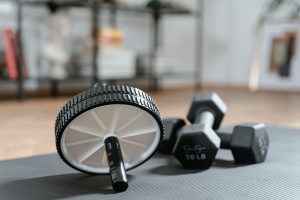
Exercise 8: Standing Ab Wheel Rollout (Advanced Progression)
The standing version of the ab wheel is significantly harder than the kneeling version, requiring elite core strength and stability. Save this for intermediate-to-advanced training.
- Starting Position: Stand holding an ab wheel (or landmine with handles) at hip height. Feet hip-width apart, core engaged, shoulders packed back and down.
- The Movement: Roll the wheel forward, extending your body toward a full-body plank position. Your core must resist all spinal extension. Roll back to start. This is incredibly challenging—even 3-5 reps counts as a solid set.
- Sets/Reps/Rest: 3 sets × 5-8 reps × 2 minutes rest.
- Form Cue: “If you feel your lower back arching excessively, you’ve gone too far forward. Stop 2-3 inches before a full extension.” Quality over quantity. One perfect rep beats five sloppy ones.
- Why it works: Creates maximum tension across all core layers by forcing massive eccentric (lengthening) and concentric (shortening) core work. This single exercise improves core strength more dramatically than 100 crunches.
Exercise 9-11: Advanced Explosive Core Exercises
These three advanced movements demand high levels of strength, power, and control. Progress to these only after mastering the first eight exercises. If you’re just starting, skip this section and return in 6-8 weeks.
Exercise 9: Hanging Leg Raise (Standing Variant)
The standing version uses a cable machine rather than a pull-up bar, making it more accessible while still demanding serious core strength. This is a legitimate abdominal and hip flexor developer.
- Starting Position: Stand facing a cable machine with the handle set at chin height. Hold the handle with both hands, arms extended. Feet slightly off the floor (suspended by arm strength), or lightly touching the floor with toes. Core engaged.
- The Movement: Lift your knees upward toward your chest, creating a 90-degree angle at the hip. Your torso remains upright—no swinging or momentum. Lower with control. That’s 1 rep.
- Sets/Reps/Rest: 3 sets × 8-12 reps × 90 seconds rest.
- Form Cue: “Lift from your core and hip flexors, not by yanking with your arms. Your arms are just holding—your core is lifting.” Control the descent for a 2-second lower.
- Why it works: Creates massive rectus abdominis activation while also demanding core stability against gravity. This is as close to a standing “crunch” as you’ll get, but far more effective.
Exercise 10: Landmine Reverse Wood Chop (Low to High)
The opposite pattern of the high-to-low wood chop, this explosive movement teaches power generation from the ground up—a crucial real-world pattern for athletic movements and functional strength.
- Starting Position: Stand perpendicular to a landmine (or cable machine set low). Feet wider than shoulder-width, knees bent. Hold the bar with both hands at your left hip. Core engaged, ready to generate power.
- The Movement: Explosively drive the bar upward and diagonally across your body, finishing at right shoulder height. Your hips extend fully as you rotate, generating power from the ground. Return to start. That’s 1 rep.
- Sets/Reps/Rest: 3 sets × 6 reps per side × 2 minutes rest (explosive work requires full recovery).
- Form Cue: “This is an explosion from your legs into your core and arms. The power starts in your feet, not your shoulders.” Use a moderate weight; focus on speed and control, not load.
- Why it works: Trains rotational power (important for tennis, baseball, martial arts) while building explosive core strength that transfers to vertical jump, sprinting, and throwing power.
Exercise 11: Decline Sit-Up (Standing Variation with Cable)
A modern take on a classic: using a cable machine to create progressive overload and strict form requirements that a traditional decline bench cannot.
- Starting Position: Set a cable machine to waist height. Stand 3-4 feet away from the machine, holding the handle at chest height with both hands. Feet shoulder-width apart, knees slightly bent. Core engaged.
- The Movement: Crunch forward (spinal flexion), bringing your elbows toward your knees. The cable creates constant tension throughout the movement. Return to start. That’s 1 rep.
- Sets/Reps/Rest: 3 sets × 15 reps × 60 seconds rest.
- Form Cue: “This is a *crunch*, not a sit-up. You’re curling your spine forward 10-15 degrees, not lying back 90 degrees. Feel your abs contract.” The cable maintains tension even at lockout.
- Why it works: While most of this article focuses on anti-movement (rotation, lateral flexion resistance), sometimes you need direct rectus abdominis work. This cable variation maintains constant tension and allows for progressive overload.
Progressive Core Training Table: Beginner to Advanced
Use this table to understand how to progress these exercises as you get stronger. The progression isn’t about doing all 11 exercises in one session—it’s about strategically advancing individual movements.
| Exercise | Beginner (Weeks 1-2) | Intermediate (Weeks 3-6) | Advanced (Weeks 7+) |
|---|---|---|---|
| Pallof Press | 2 sets × 10 reps, light band | 3 sets × 12 reps, cable 20 lbs | 4 sets × 15 reps, cable 35+ lbs |
| Landmine Rotation | 2 sets × 6 reps, 25 lbs | 3 sets × 10 reps, 35 lbs | 4 sets × 12 reps, 45+ lbs |
| Farmer’s Carry | 3 sets × 30 sec, 25 lbs per hand | 3 sets × 45 sec, 45 lbs per hand | 4 sets × 60 sec, 70+ lbs per hand |
| Med Ball Slam | 2 sets × 5 reps, 8 lbs | 3 sets × 8 reps, 12 lbs | 4 sets × 10 reps, 16+ lbs |
| Suitcase Carry | 3 sets × 30 sec, 20 lbs | 3 sets × 50 sec, 35 lbs | 4 sets × 70 sec, 55+ lbs |
| Ab Wheel Rollout (Standing) | Not recommended for beginners | 2 sets × 4-5 reps, partial range | 3 sets × 8 reps, full range |
Get Free Weekly Workout Plans
Join Coach Alex every week for:
✅ Proven home workout plans ✅ Nutrition tips ✅ Gear reviews
📚 Keep Reading
→7 Best Fitness Apps for Beginners in 2025: Step-by-Step Guide→How to Work Out During Your Lunch Break: 2024 Science-Backed Guide→Best Exercises for Toned Stomach After 40: Complete 2024 Guide
8 Years Experience · Home Fitness Expert
Alex is a NASM-certified personal trainer who has helped thousands of beginners build lasting fitness habits at home — no gym required. His no-fluff approach focuses on what actually works for real people with busy lives. Find his recommended gear at Aura Heaven.