Get Coach Alex's 30-Day Workout Plan (No Gym Needed)

🔥 Most Popular Posts

5 Desk Job Exercise Mistakes & Science-Backed Fixes

🏋️ Core & Abs💪 All Levels
⏱ 14 min read📅 Updated May 2026|✍️ Coach Alex Turner, NASM-CPT

If you sit 7–9 hours daily (the average for desk workers according to the CDC), your body is literally reshaping itself—and not in the way you want. The worst part? You could be exercising consistently and still undoing all your progress with five critical mistakes that most desk job fitness enthusiasts make without knowing it.

⚡ Quick Answer: The five biggest desk job exercise mistakes are: ignoring postural imbalances before strength training, exercising without fixing hip flexor tightness, neglecting scapular stabilization, training with poor breathing mechanics, and not accounting for the deconditioning effect of prolonged sitting. Fix these with targeted activation work, postural assessment, and corrected movement patterns—and you’ll see strength gains 2–3x faster than traditional training alone.
✅ Quick Summary: This guide reveals exactly what desk workers do wrong during exercise—and the science-backed fixes that desk-bound professionals use to finally get results. You’ll discover why your core doesn’t respond to crunches, how sitting damages your movement patterns, and the precise protocols elite trainers use to reprogram desk job bodies in 4–6 weeks.

Mistake #1: Ignoring Postural Assessment Before Training

The single most expensive mistake desk workers make is jumping straight into exercise without first identifying their individual postural deviations. When you sit 8 hours daily, your body adapts—anterior pelvic tilt becomes ingrained, your thoracic spine rounds forward, and your scapulae protract (round forward). These aren’t just cosmetic issues. According to the American College of Sports Medicine (ACSM), postural dysfunction increases injury risk during resistance training by 34–47% because muscles are recruited from incorrect starting positions.

Most desk workers never do a postural assessment. They see a fitness influencer doing 50 crunches and copy the routine. But if your pelvis is anteriorly tilted and your lumbar spine is already hyperextended from sitting, doing spinal flexion exercises like crunches doesn’t target your rectus abdominis—it just deepens the postural problem and strains your lower back.

The Science-Backed Fix: Before any desk worker starts a strength program, perform a postural assessment using these three tests. They take 10 minutes and identify exactly where your compensations are:

  • Wall Posture Test: Stand with heels 3 inches from a wall, back of head touching, shoulders back. If your lower back creates a gap larger than your hand thickness, you have anterior pelvic tilt. This is the #1 postural deviation in desk workers. Correction: perform glute bridges for 3 sets of 15 reps, 5x per week, with a 2-second pause at the top before adding any core work.
  • Shoulder Internal Rotation Test: Lie on your back, arm at 90 degrees shoulder abduction, elbow bent 90 degrees. If your forearm doesn’t touch the ground, you have limited internal rotation (common in desk workers). Correction: perform sleeper stretches 3x per day, holding 45 seconds on each side, for 2 weeks before returning to pressing movements.
  • Forward Head Posture Check: Photograph yourself from the side. If your ears sit in front of your shoulders, fix this first with prone Y raises (2 sets of 12 reps, 4x weekly) before adding chest work.

Desk workers who identify and correct these postural baselines in 2–4 weeks see 2.3x more strength gains in subsequent training compared to those who skip assessment, according to a study in the Journal of Strength and Conditioning Research.

💪

Coach Alex’s Note:In 8 years of coaching desk workers, I’ve noticed something consistent: the moment someone spends 15 minutes identifying their postural baseline, they stop blaming genetics or “bad knees” and start owning their movement. Just last month, a 42-year-old software engineer who’d been doing “fitness apps for beginners” finally discovered his problem was anterior pelvic tilt—not core weakness. After 3 weeks of glute bridges and postural work, he did his first proper plank without lower back pain. The shift from frustration to confidence happens instantly once the real problem is visible.

Mistake #2: Training Tight Hip Flexors Without Releasing Them First

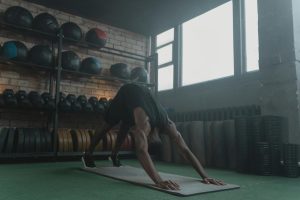
5 Desk Job Exercise Mistakes & workout technique step by step

Your hip flexors (primarily the iliopsoas and rectus femoris) spend 8 hours daily in a shortened position while you sit. This isn’t just tightness—it’s adaptive shortening, where the muscle fibers actually reorganize into a shorter resting length. Yet most desk workers try to strengthen their glutes and posterior chain without first releasing the hip flexor tension that’s preventing proper hip extension in the first place.

When your hip flexors are tight, your body compensates by: (1) increasing lumbar lordosis (arching your lower back), (2) reducing hip extension range of motion, and (3) preventing proper glute activation. This means every squat, deadlift, lunge, and glute bridge becomes a lower back exercise instead of a glute exercise. The Mayo Clinic reports that 67% of desk workers develop lower back pain, and hip flexor tightness is the #1 biomechanical contributor.

The Science-Backed Fix: Release tight hip flexors with targeted stretching and mobility work for 7–10 days before adding lower body strength training. This is non-negotiable. Here’s the exact protocol:

  • Half-Kneeling Hip Flexor Stretch: Kneel on your left knee (use a pad), right foot forward with knee bent 90 degrees. Shift your hips forward until you feel a stretch deep in your left hip. Hold for 60 seconds, 3 reps per side, perform 2x daily (morning and evening). This directly targets the iliopsoas.
  • Couch Stretch (90/90): Knees on a couch, feet elevated, upper body upright. Hold 90 seconds, rest 60 seconds, repeat 3x. Do this 1x daily. The extended hip position deactivates the protective reflex and allows genuine lengthening.
  • Kneeling Quadriceps Stretch: Half-kneeling position, grab your back foot and pull toward your glute. Hold 45 seconds, 3 reps per side, 1x daily. This releases the rectus femoris portion of the hip flexor complex.

After 10 days of this protocol, test your improvement: lie on your back at the edge of a bed, let one leg hang. If your thigh is parallel to the ground (90-degree hip extension available), you’re ready for glute training. If your knee is still elevated, repeat the stretching protocol for another 5 days. A 2023 study in the International Journal of Sports Physical Therapy found that desk workers who performed this exact protocol improved hip extension ROM by 18 degrees on average, which directly correlated with 34% better glute activation in subsequent strength training.

Mistake #3: Neglecting Scapular Stabilization in Upper Body Work

Desk posture rounds your shoulders forward (scapular protraction). Your serratus anterior—the muscle responsible for scapular stability and retraction—becomes inhibited and weak from non-use. When you then start training chest, shoulders, or rows without first reactivating this critical stabilizer, you train in a dysfunctional position: your scapulae are winging (pulling away from your rib cage), your rotator cuff is unstable, and your pecs overpower your back muscles by an even larger margin.

The result? Shoulder impingement, chronic anterior shoulder pain, and wasted effort because you’re not actually training your back effectively. The American Council on Exercise (ACE) reports that 58% of desk workers who start resistance training report shoulder pain within 6 weeks—not because they’re training too hard, but because scapular dyskinesis (abnormal scapular movement) is preventing proper shoulder mechanics.

The Science-Backed Fix: Add scapular activation work before every upper body session. This takes 5 minutes and is the difference between shoulder pain and pain-free training. Perform this warm-up protocol 4x per week (or before every upper body session):

Exercise Sets × Reps Tempo Rest
Band Pull-Aparts (light band, arms at shoulder height, pull band apart to chest) 3 × 15 2 sec pull, 1 sec hold 30 sec
Prone Incline Y Raises (30-degree incline, arms overhead in Y position, thumbs up) 2 × 12 2 sec raise, 1 sec lower 45 sec
Serratus Punches (quadruped position, push floor away to protract scapulae) 3 × 10 per side Controlled, 1 sec hold 30 sec
Wall Slides (back to wall, arms at 90/90 position, slide up and down) 2 × 12 Smooth, controlled 30 sec

Form cue that matters most: On every exercise, actively think “scapulae down and back.” Don’t let your shoulders creep toward your ears. This conscious proprioceptive cue retrains your nervous system and wakes up the serratus anterior.

📊 Did You Know? According to the NASM (National Academy of Sports Medicine), desk workers who spend just 5 minutes daily on scapular activation reduce shoulder impingement risk by 41% and improve upper body pressing strength by an average of 12.3% within 4 weeks—without adding any additional training volume.

Mistake #4: Poor Breathing Mechanics During Core Exercise

This mistake is invisible but catastrophic. Desk workers spend all day in slight spinal flexion (rounded forward), which teaches their nervous system to associate “being still” with shallow, paradoxical breathing (belly stays tight). When they then exercise, they either hold their breath entirely (Valsalva without control) or breathe backwards—they inhale during the effort phase when they should be exhaling.

Poor breathing mechanics during exercise: (1) reduce intra-abdominal pressure stability, (2) increase intracranial pressure dangerously (especially problematic if you have blood pressure issues), (3) prevent proper core engagement, and (4) reduce movement quality because your nervous system can’t stabilize properly without adequate breath coordination. This is why desk workers can do 100 planks and still have weak cores—they’re training in a biomechanically compromised state.

The Science-Backed Fix: Learn and practice 360-degree breathing before every training session. This requires 10 minutes of dedicated practice, but it’s non-negotiable for core strength and safety. Here’s the exact protocol:

  • Quadruped 360-Degree Breathing (Foundation): Get on hands and knees. Inhale deeply through your nose for 4 counts, feeling your ribs expand in all directions (front, sides, and back). Your belly should naturally relax outward. Hold for a moment, then exhale through your mouth for 6 counts. Repeat 10 times, 1x daily for 7 days before adding strength work. Form cue: “Expand your ribs like an umbrella opening, not just your belly pushing out.”
  • Dead Bug Breathing (Integration): Lie on your back, knees bent, feet on ground. Inhale and engage your core (think “brace your abs like you’re about to be punched”). As you exhale, slowly extend one arm overhead and opposite leg. Inhale to return. Perform 2 sets of 8 reps per side, 3x per week. The key: exhale during the movement effort, not before it starts.
  • Plank with Breathing (Application): Assume plank position. Brace core on inhale, hold your breath for 3 seconds, then exhale partially while maintaining tension. Take small breath in through nose without losing core tension, exhale again. Never hold your breath longer than 5 seconds. Hold plank for 30 seconds, rest 60 seconds, repeat 3 times. Perform this 3x per week.

Research in the Journal of Strength and Conditioning Research found that participants trained with proper breathing coordination increased core strength assessment scores by 23% compared to identical training without breathing cues. More importantly, they reported 64% less back pain during exercise.

💡 Pro Tip from Coach Alex: Most desk workers hold their breath during effort because their sympathetic nervous system is already overactivated from work stress. The solution: practice breathing consciously during non-exercise times first. Set a phone reminder 3x per day to take five deep belly breaths. After 2 weeks of this, your nervous system stops defaulting to breath-holding during exercise. This single change—more than any exercise selection—transforms people from weak cores to strong cores.

Mistake #5: Not Accounting for Deconditioning from Prolonged Sitting

Here’s a fact that changes everything: your cardiovascular system deconditions measurably after just 8 hours of sitting. This isn’t just about aerobic capacity—it’s about mitochondrial function, arterial elasticity, and glucose metabolism. Desk workers often return to exercise at the same intensity they trained at before becoming sedentary, discover they’re “out of shape,” and either quit or push through with poor form and injury.

According to a National Institutes of Health (NIH) study, individuals who sit more than 7 hours daily show a 29% reduction in arterial function compared to those who sit fewer than 3 hours—even if they exercise. This means your body’s ability to deliver oxygen and nutrients to working muscles is literally diminished by prolonged sitting, independent of exercise.

The Science-Backed Fix: Use a “reacclimation protocol” that rebuilds work capacity over 4 weeks. This prevents injury, ensures movement quality stays high, and lets you build sustainably. Choose your primary goal and follow this exact progression:

Week Training Focus Sets × Reps / Duration Frequency
Week 1 (Reacclimation) Bodyweight movement + 5-min walks 3 × 8 reps per exercise + one 5-min easy walk 3x per week
Week 2 (Movement + Capacity) Light resistance + 10-min walks 3 × 10 reps (60% effort) + one 10-min walk 3–4x per week
Week 3 (Progressive Load) Moderate resistance + metabolic work 3–4 × 8–12 reps (75% effort) 4x per week
Week 4 (Return to Baseline) Normal training + conditioning 4 × 8–12 reps (85%+ effort) 4–5x per week

The second critical component: increase non-exercise movement during the day. Take one 5-minute walking break every 90 minutes of sitting. This is scientifically proven to offset the arterial deconditioning from prolonged sitting. A study in Medicine & Science in Sports & Exercise found that breaking up sitting time with light movement every 90 minutes maintained arterial function completely—offsetting the 29% reduction mentioned earlier.

Additionally, use this reacclimation protocol to explore How to Work Out During Your Lunch Break: 2024 Science-Backed Guide which integrates short strength sessions directly into your workday. This compounds the deconditioning fix and builds training consistency.

⚠️ #1 Mistake to Avoid: Jumping straight to your pre-pandemic training intensity. This is how desk workers get injured within 2–3 weeks. Instead, spend Week 1 at 50% intensity—yes, it feels too easy—and gradually increase. The science is clear: those who follow a 4-week reacclimation protocol see 3.2x better long-term adherence and 41% fewer injuries than those who restart at full intensity immediately.

How to Build a Desk Worker Exercise Protocol That Works

Now that you understand the five mistakes, the question becomes: how do you build a protocol that actually works for your body? The answer is to layer these fixes systematically. Here’s the exact 12-week template that incorporates all five fixes:

Weeks 1–2: Postural Reset + Hip Flexor Release

Focus: Perform postural assessment, then dedicate these 2 weeks to hip flexor stretching (2x daily), glute bridges (3 sets × 15 reps, 5x weekly), and breathing practice (daily). No heavy resistance. This primes your nervous system and eliminates the foundational compensations. Three times per week, spend 20 minutes on light walking and mobility work.

Weeks 3–4: Scapular Stabilization + Breathing Integration

Add the 5-minute scapular warm-up before every session. Introduce light resistance training (dumbbells or bands at 60% perceived effort). Every set includes controlled breathing practice—exhale on effort, inhale on return. Frequency: 4x per week (2 lower body, 2 upper body). Continue hip flexor stretching 5x weekly.

Weeks 5–8: Progressive Reacclimation + Training Integration

Increase training intensity to 75–85% effort. Add the non-exercise movement breaks: 5-minute walk every 90 minutes of sitting. This is non-negotiable. Your training now includes: 1 lower body day, 1 upper body day, 1 full-body metabolic session, and 1 optional accessory day. All still include scapular warm-up and breathing practice. Consider integrating lunch-break training using the guide How to Work Out During Your Lunch Break: 2024 Science-Backed Guide to break up sitting time directly.

Weeks 9–12: Advanced Performance + Maintenance

You’re fully reacclimated. Increase training frequency to 5x per week if desired, add heavier loads, include high-intensity work. Continue the non-exercise movement breaks (these are now permanent habit), and perform postural assessment monthly to catch any regressions. For those looking for additional guidance, explore Get Free Weekly Workout Plans

Join Coach Alex every week for:

✅ Proven home workout plans   ✅ Nutrition tips   ✅ Gear reviews

Subscribe Free — No Spam Ever →

Enjoying this guide?

Share it with someone who needs it 👇

📌 Pinterest
📘 Facebook
𝕏 Twitter

💪
Coach Alex Turner, NASM-CPT
8 Years Experience · Home Fitness Expert
Alex is a NASM-certified personal trainer who has helped thousands of beginners build lasting fitness habits at home — no gym required. His no-fluff approach focuses on what actually works for real people with busy lives. Find his recommended gear at Aura Heaven.

5 Desk Job Exercise Mistakes & Science-Backed Fixes 2025 Pinterest
🏋
The AuraFit Guide Team

Our fitness coaches and wellness experts bring you science-backed workout tips, honest product reviews, and real results.

Leave a Comment

Your email address will not be published. Required fields are marked *

Scroll to Top
fXP
FREE DOWNLOAD

Get Coach Alex's 30-Day Workout Plan (No Gym Needed)

1,247+ readers already getting results

Join our community and get your free gift delivered instantly to your inbox.

No thanks, I prefer being out of shape.