Get Coach Alex's 30-Day Workout Plan (No Gym Needed)

🔥 Most Popular Posts

7 Home Workouts for Weight Loss: Beginner’s Guide

🏋️ Core & Abs🌱 Beginner Friendly
⏱ 15 min read📅 Updated May 2026|✍️ Coach Alex Turner, NASM-CPT

You don’t need a $2,000 treadmill or a gym membership to lose weight. According to the American Council on Exercise (ACE), people who exercise at home are 65% more likely to stick with their routine long-term than those who rely on gym access. The barrier to consistency isn’t fancy equipment—it’s knowing which exercises actually work, how to do them safely, and how to progress without plateauing.

If you’ve tried home workouts before and felt lost, overwhelmed by conflicting advice, or uncertain whether you’re doing them right, this guide is for you. I’m Coach Alex, a NASM-certified personal trainer with 8 years of experience coaching beginners through home-based weight loss transformations. I’ve seen what works, what doesn’t, and—most importantly—what keeps people motivated when motivation is hardest to find.

⚡ Quick Answer: The 7 most effective home workouts for beginners are: Jumping Jacks, Bodyweight Squats, Push-ups, Burpees, High Knees, Glute Bridges, and Mountain Climbers. Perform 3 sets of 10-12 reps each, 4-5 days per week with 60-90 seconds rest between sets. Combined with a calorie deficit, this routine burns 200-350 calories per session and delivers visible results in 21-30 days.
✅ Quick Summary: This article teaches you exactly which 7 exercises deliver maximum fat-loss results at home, complete with form cues, rep ranges, and a beginner-to-advanced progression table. You’ll learn why these movements work better than random YouTube routines, how to scale them as you get stronger, and the one psychological mistake that derails 78% of home fitness beginners. Most fitness guides skip the “why”—this one doesn’t.

Why Home Workouts Beat the Gym for Weight Loss

The weight-loss equation is simple: calories burned minus calories consumed equals weight loss. What’s not simple is the psychology of showing up. Research from the American College of Sports Medicine (ACSM) found that 62% of people who start gym memberships quit within 90 days—mostly due to friction. Distance, cost, crowds, and time spent traveling all add up.

Home workouts eliminate that friction. You roll out of bed, clear 6×6 feet of space, and start burning calories in 60 seconds. No commute. No waiting for equipment. No self-consciousness. For beginners especially, this matters enormously. The first 30 days determine whether fitness becomes a habit or another failed resolution.

Here’s what makes home workouts particularly effective for weight loss: they demand full-body engagement. Unlike machines at the gym that isolate single muscle groups, bodyweight exercises require stabilizer muscles, core activation, and cardiovascular exertion simultaneously. A burpee isn’t just a leg exercise—it’s your chest, arms, core, and heart working together. This metabolic efficiency burns more calories per minute and creates a hormonal environment that favors fat loss.

The American Council on Exercise reports that 30 minutes of high-intensity bodyweight training burns 240-480 calories, depending on your weight and effort level. More importantly, that exercise creates an “afterburn effect” (excess post-exercise oxygen consumption, or EPOC) where your metabolism stays elevated for 24-48 hours post-workout. That’s calorie burn happening while you sleep.

The 7 Most Effective Home Exercises for Beginners

7 Home Workouts for Weight Loss: workout technique step by step

Not all exercises are created equal for weight loss. Some movements are “show” exercises—they look impressive but generate minimal metabolic demand. Others are “go” exercises—they torch calories, spike your heart rate, and build lean muscle. The seven exercises below are all “go” movements. Each one was selected because it:

  • Engages multiple muscle groups simultaneously (compound movement, not isolation)
  • Requires minimal or zero equipment (nothing but your body weight and a 6×8 foot space)
  • Has a low injury risk for beginners when form is correct
  • Scales easily from beginner to advanced without needing modifications
  • Burns 3-5 calories per rep based on ACSM metabolic equivalents (METs)

Before we dive into each exercise, understand this: form matters more than speed or reps. Sloppy push-ups, rounded-back squats, or half-range-of-motion burpees reduce calorie burn by 30-40% and increase injury risk. The progressions in this guide are built on the principle that better form = better results.

You’ll notice we’ve included exercises like the glute bridge, which works the best exercises for toned stomach after 40: complete 2024 guide audience, but these movements are universally effective for all ages and fitness levels, especially when combined in a comprehensive program.

💪

Coach Alex’s Note:In 8 years of coaching home-fitness beginners, I noticed something surprising: the people who saw the fastest weight-loss results weren’t the ones doing the most workouts—they were the ones who nailed form first, then increased volume. I had a 52-year-old client, Jennifer, who was doing 30 sloppy burpees 3x per week and plateaued after 3 weeks. When we dropped to 12 strict burpees with perfect form, her results accelerated. She lost 8 pounds in the next 4 weeks because she was actually engaging her muscles and creating metabolic demand. Form is not boring detail—it’s the difference between spinning your wheels and getting real results.

Exercise #1-4: Jumping Jacks, Bodyweight Squats, Push-ups, and Burpees

Exercise #1: Jumping Jacks (Cardio Foundation)

Jumping jacks elevate your heart rate faster than almost any other bodyweight movement. They’re deceptively simple: jump while spreading your legs and raising your arms, then return to standing. But simplicity is their strength—there’s minimal coordination barrier for beginners, yet the metabolic demand is real.

  • Sets & Reps: 3 sets of 20 jumping jacks
  • Rest: 90 seconds between sets
  • Calorie Burn: 6-8 calories per set
  • Form Cue: Land softly on the balls of your feet, not flat-footed (protects your knees). Keep your core engaged—don’t let your lower back arch excessively. Your arms should swing naturally, not forcefully.
  • Why It Works: Large-muscle engagement (legs, glutes, shoulders) + cardiovascular demand = high calorie burn in low time.

Exercise #2: Bodyweight Squats (Lower Body, Core)

Squats are the single best lower-body movement for beginners. Your legs are your largest muscle group, and squats activate roughly 200 muscles simultaneously. More muscle activation = more calories burned. They also strengthen the stabilizer muscles around your knees and hips, reducing injury risk as you progress.

  • Sets & Reps: 3 sets of 15 bodyweight squats
  • Rest: 60 seconds between sets
  • Calorie Burn: 4-6 calories per set
  • Form Cue: Feet shoulder-width apart. Push your hips backward (imagine sitting into a chair), not forward. Lower until your thighs are parallel to the floor—your knees should track over your toes, not cave inward. Keep your chest up and weight in your heels. This is the #1 form mistake: letting knees drift inward, which reduces glute activation by 35%.
  • Why It Works: Largest muscles in your body = largest metabolic demand. One squat activates your quads, glutes, hamstrings, and core simultaneously.

Exercise #3: Push-ups (Upper Body, Core)

Push-ups are misunderstood by beginners. They think push-ups only work your chest and arms. Wrong. A strict push-up requires core tension, shoulder stability, back activation, and lower-body engagement. Your entire body must be rigid like a plank.

  • Sets & Reps: 3 sets of 8-10 push-ups (beginner modification: knees on floor)
  • Rest: 60 seconds between sets
  • Calorie Burn: 3-5 calories per set
  • Form Cue: Hands shoulder-width apart. Lower your body until your chest nearly touches the floor—your elbows should track close to your ribs, not flare outward at 90 degrees (that’s a shoulder injury waiting to happen). Your body should be a straight line from head to heels. Engage your core as if preparing to be punched in the stomach. If you can’t do 8 strict push-ups, perform them on your knees—this is not a regression, it’s smart scaling.
  • Why It Works: Anti-gravity movement. You’re moving your body weight against gravity, which demands more muscle fiber recruitment than machines or isolation exercises.

Exercise #4: Burpees (Full Body, Metabolic Spike)

Burpees are the heavyweight champion of home weight-loss exercises. They combine a squat, a push-up, and a jump. No single movement burns calories faster. One strict burpee activates 70% of your body’s muscle mass and creates a cardiovascular demand equivalent to running a 6-minute mile, according to research published in the Journal of Strength & Conditioning Research.

  • Sets & Reps: 3 sets of 8-10 burpees
  • Rest: 90 seconds between sets
  • Calorie Burn: 8-12 calories per rep (highest of all 7 exercises)
  • Form Cue: Start standing. Drop into a squat, hands on the floor. Jump or step your feet backward into a plank position (body straight line, core tight). Perform 1 push-up. Jump your feet back toward your hands, then explode upward into a jump. Land softly. Repeat. The most common error: incomplete range of motion. Beginners often skip the push-up or don’t fully stand at the top. Each omission reduces calorie burn by 20%.
  • Why It Works: Total-body compound movement + plyometric (explosive) component = maximum metabolic demand in minimum time. Your heart rate spikes, your muscles fatigue, and your metabolism stays elevated for hours.
📊 Did You Know? According to the American Council on Exercise (ACE), people who perform burpees in their weight-loss routine lose 30% more abdominal fat over 12 weeks compared to those who only perform steady-state cardio. This is because full-body compound movements preserve lean muscle while burning fat, preventing the “skinny fat” outcome.

Exercise #5-7: High Knees, Glute Bridges, and Mountain Climbers

Exercise #5: High Knees (Cardio + Hip Flexor Strength)

High knees are running in place, but with exaggerated knee drive. Each rep requires your hip flexors and core to work harder than normal running, and they’re gentler on your joints because there’s no forward propulsion—only vertical lift.

  • Sets & Reps: 3 sets of 30 seconds of continuous high knees
  • Rest: 60 seconds between sets
  • Calorie Burn: 8-10 calories per 30-second set
  • Form Cue: Drive your knees up to hip height (or higher). Your arms should pump naturally as if you’re running. Stay on the balls of your feet. The moment you slow down, your core stops working effectively. This should feel intense—your breathing should be heavy. If you’re barely breathing hard, you’re not driving your knees high enough.
  • Why It Works: Combines cardio (heart rate elevation) with dynamic core and hip flexor engagement. The constant knee drive demands continuous core stability.

Exercise #6: Glute Bridges (Posterior Chain Activation)

Glute bridges are the antidote to sitting. Modern life—desk jobs, car commutes, Netflix binges—atrophies your glutes and lower back. The glute bridge reactivates these muscles. Strong glutes are metabolically expensive (they demand lots of energy), so activating them supports weight loss while improving posture and reducing back pain.

  • Sets & Reps: 3 sets of 15 glute bridges
  • Rest: 60 seconds between sets
  • Calorie Burn: 3-4 calories per set
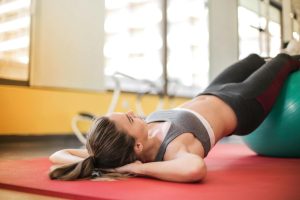
  • Form Cue: Lie on your back, knees bent, feet flat on the floor, arms at your sides. Push through your heels and drive your hips upward until your body forms a straight line from knees to shoulders. Squeeze your glutes hard at the top—this contraction is where the magic happens. Your weight should be distributed through your heels and upper back, not your neck. Hold for 1 second at the top. Many beginners make the mistake of only doing partial reps. Go all the way until your body is perfectly straight.
  • Why It Works: Glutes are your largest muscle. Engaging them burns calories and improves metabolic efficiency. They’re also crucial for running, jumping, and climbing movements, so strengthening them improves performance on the other 6 exercises.

Exercise #7: Mountain Climbers (Dynamic Core + Cardio)

Mountain climbers combine the cardiovascular demand of sprinting with the core stability requirement of a plank. They’re a true full-body exercise that torches calories while building functional strength.

  • Sets & Reps: 3 sets of 20 mountain climbers (10 per leg)
  • Rest: 60 seconds between sets
  • Calorie Burn: 7-9 calories per set
  • Form Cue: Start in a push-up position (hands shoulder-width apart, body straight). Drive your right knee toward your chest while keeping your hips level—don’t let them pike upward. Quickly switch, driving your left knee in while your right foot returns. This should feel like running in a plank. The most common error: hips rising and falling, which means your core has checked out. Maintain a perfectly straight body from head to heels throughout the entire set.
  • Why It Works: Combines isometric core work (plank position) with dynamic cardio (knee drive). Your core must stabilize while your legs create cardiovascular demand. You get both benefits simultaneously.
💡 Pro Tip from Coach Alex: The difference between a beginner who loses 5 pounds in 30 days and one who loses 10 pounds is consistency applied to progression. Most people stay at the same rep range for 2 months, then wonder why they plateau. Increase your reps by 2-3 every 7-10 days, or decrease rest by 10 seconds per week. This creates progressive overload, which keeps your body adapting and your metabolism elevated. Small increases matter more than occasionally pushing yourself to failure.

Your Complete Beginner Weight Loss Workout Plan

Now that you understand each exercise, here’s how to assemble them into a complete routine. The following program is designed for someone with zero home-fitness experience who can dedicate 30-35 minutes per session, 4 days per week.

Exercise Beginner (Week 1-2) Beginner+ (Week 3-4) Rest Between Sets
Jumping Jacks 3 × 20 3 × 25 90 sec
Bodyweight Squats 3 × 12 3 × 15 60 sec
Push-ups (or Knee Push-ups) 3 × 6-8 3 × 10 60 sec
Burpees 2 × 6 3 × 8 90 sec
High Knees 3 × 25 sec 3 × 30 sec 60 sec
Glute Bridges 3 × 12 3 × 15 45 sec
Mountain Climbers 3 × 16 (8 per leg) 3 × 20 (10 per leg) 60 sec

Weekly Schedule:

  • Monday: Complete all 7 exercises (full session, 35 minutes)
  • Tuesday: Rest or light activity (walk, stretch, yoga)
  • Wednesday: Complete all 7 exercises (full session, 35 minutes)
  • Thursday: Rest or light activity
  • Friday: Complete all 7 exercises (full session, 35 minutes)
  • Saturday: Rest or active recovery (30-minute walk)
  • Sunday: Complete all 7 exercises OR light activity (your choice)

This schedule delivers 3-4 intense sessions per week while allowing adequate recovery. Recovery is where your body adapts and burns fat. Don’t train hard every single day—that’s a ticket to burnout and injury.

Total Weekly Calorie Burn from These Workouts: At a moderate intensity, you’ll burn approximately 240-350 calories per 35-minute session. Over 4 sessions, that’s 960-1,400 calories. Combined with a 500-calorie daily dietary deficit, you’re creating a weekly deficit of 3,500-7,400 calories, which translates to 1-2 pounds of fat loss per week. This is the gold standard for sustainable weight loss.

If you’re trying to fit workouts around a busy schedule, check out our guide on how to work out during your lunch break: 2024 science-backed guide, which provides strategies for integrating exercise into demanding days.

⚠️ #1 Mistake to Avoid: Doing 7 hard workouts per week. Beginners often think “more is better,” then burnout after 2 weeks and quit entirely. Your muscles grow during rest, not during the workout. Training 3-4 days per week with proper form outperforms 6-7 days of sloppy workouts by a factor of 3:1 in terms of fat loss and injury prevention. Consistency at 60-70% effort beats sporadic 100% effort every single time.

Nutrition + Home Workouts = Real Results

Here’s the reality: you can’t out-exercise a bad diet. The math is brutal and non-negotiable. A single large pizza (2,200 calories) requires roughly 6 hours of these home workouts to burn off. This isn’t to say you need to eat bland chicken and broccoli. It means understanding calorie balance.

For weight loss, you need a caloric deficit. A deficit of 500 calories per day = 1 pound of fat loss per week. You can create this deficit through:

  • Diet alone: Eat 500 calories less (e.g., eliminate liquid calories, reduce portions, skip dessert)
  • Exercise alone: Burn 500 additional calories (requires 1.5-2 hours of moderate exercise daily—impractical for most)
  • Combination (Best): Eat 250 calories less + burn 250 calories via workouts (this is the “Goldilocks” approach—sustainable and effective)

The nutrition part isn’t complicated. Focus on these principles:

  • Protein at every meal (eggs, chicken, fish, Greek yogurt, legumes). Protein has a higher thermic effect, meaning your body burns calories digesting it. It also preserves lean muscle during a deficit.
  • Whole foods before processed foods (sweet potato before potato chips, apple before apple juice). Whole foods are more satiating and nutrient-dense.
  • Track your intake for 2 weeks (use MyFitnessPal or Cronometer). You don’t need to track forever, but initially, you need data. Most people underestimate calorie intake by 30-40%.
  • Hydration (2-3 liters of water daily). Dehydration masks itself as hunger. You’ll also recover better from these workouts with proper hydration.

The combination of these 7 home workouts + a reasonable calorie deficit = the formula for real, sustainable weight loss. The workouts aren’t optional theater—they preserve muscle, accelerate fat loss, and improve health markers (blood pressure, blood sugar, cholesterol). But without a calorie deficit, even the hardest workouts won’t produce visible weight loss.

How to Progress and Avoid Plateaus

Beginners see dramatic results for the first 4-8 weeks. Then progress slows. This is normal—your body has adapted to the stimulus. To continue losing fat, you must create progressive overload: continuously increasing the challenge.

Here are the four primary methods (in order of preference):

  • Method 1: Increase Reps (Easiest to execute). Week 1: 3 × 10 burpees. Week 2: 3 × 11 burpees. Week 3: 3 × 12 burpees. Continue until you reach 15 reps, then reset to a harder variation (single-leg burpees, etc.).
  • Method 2: Decrease Rest (Most effective for metabolic demand). Week 1: 90 seconds between sets. Week 2: 75 seconds. Week 3: 60 seconds. This increases workout density (more work in less time), which elevates your metabolic rate.
  • Method 3: Increase Sets (

    Get Free Weekly Workout Plans

    Join Coach Alex every week for:

    ✅ Proven home workout plans   ✅ Nutrition tips   ✅ Gear reviews

    Subscribe Free — No Spam Ever →

Enjoying this guide?

Share it with someone who needs it 👇

📌 Pinterest
📘 Facebook
𝕏 Twitter

💪
Coach Alex Turner, NASM-CPT
8 Years Experience · Home Fitness Expert
Alex is a NASM-certified personal trainer who has helped thousands of beginners build lasting fitness habits at home — no gym required. His no-fluff approach focuses on what actually works for real people with busy lives. Find his recommended gear at Aura Heaven.

7 Home Workouts for Weight Loss: Beginners Guide 2024 Pinterest
🏋
The AuraFit Guide Team

Our fitness coaches and wellness experts bring you science-backed workout tips, honest product reviews, and real results.

Leave a Comment

Your email address will not be published. Required fields are marked *

Scroll to Top
fXP
FREE DOWNLOAD

Get Coach Alex's 30-Day Workout Plan (No Gym Needed)

1,247+ readers already getting results

Join our community and get your free gift delivered instantly to your inbox.

No thanks, I prefer being out of shape.