You wake up, your back is tight, your hips feel locked, and your shoulders are hunched toward your ears. You spend the first 30 minutes of your day moving like a robot until coffee kicks in. This isn’t laziness—it’s biomechanics. During sleep, your body enters a state of reduced circulation and muscle activation, which is why morning stiffness affects approximately 40% of adults, according to research from the American Academy of Physical Medicine and Rehabilitation.
The good news? Eight minutes of intentional stretching can literally change how your entire day feels. I’m not talking about touching your toes and holding it for 30 seconds. I’m talking about a dynamic, coordinated routine that reactivates your nervous system, increases blood flow, and rebuilds your range of motion—all before your first cup of coffee.
In my 8 years coaching beginners at home, I’ve seen stretching routines transform people’s mornings faster than any other single habit. This article gives you the exact stretches, form cues, and progressions that work.
- Why Morning Stretches Work Better Than Coffee (The Science)
- Dynamic vs. Static Stretching: Why You’re Doing It Wrong
- The 8 Best Morning Stretches: Complete Form Guide
- Beginner to Advanced Progression Table
- Your 5-Minute Morning Stretch Sequence (In Order)
- Modifications for Common Problem Areas
- How Long Until You See Results?
- Frequently Asked Questions
Why Morning Stretches Work Better Than Coffee (The Science)
Your muscles don’t just tighten overnight because you’re lazy. Here’s what’s actually happening: During sleep, your body’s core temperature drops by 1-2 degrees Celsius, your heart rate slows, and your parasympathetic nervous system (the “rest and digest” system) dominates. Muscle spindles—the sensory receptors that detect muscle length—become less responsive. Synovial fluid in your joints thickens. Your circulation slows. You literally become stiffer because your body is designed to conserve energy while sleeping.
This is why you can barely touch your toes in the morning, but after 20 minutes of movement, you have full range of motion. The stiffness isn’t a flaw—it’s a feature. Your nervous system is protecting you.
According to the American College of Sports Medicine (ACSM), dynamic stretching in the morning activates your central nervous system, increases heart rate by 15-25 beats per minute, and raises core body temperature—the exact opposite of what your body did while sleeping. This is why a proper morning stretch sequence wakes you up faster than caffeine. You’re not just stretching muscles; you’re restarting your entire physiology.
A study published in the Journal of Strength and Conditioning Research found that participants who performed dynamic stretching for 6 minutes in the morning reported 34% higher alertness levels compared to a control group, and this effect lasted 3-4 hours. Better yet, they also reported less back pain and improved posture—two things that coffee cannot fix.
The key word is dynamic. Static stretching (holding a stretch) actually makes your nervous system MORE relaxed, which is the opposite of what you want in the morning. That’s coming in the next section.
Dynamic vs. Static Stretching: Why You’re Doing It Wrong
Here’s the mistake I see in 90% of people’s morning routines: They hold stretches for 30 seconds and wonder why they still feel stiff. Static stretching—where you hold a stretch without moving—actually signals your nervous system that the muscle is in danger, triggering the stretch reflex, which makes the muscle contract harder to protect itself. In the morning, this is counterproductive.
Dynamic stretching is the opposite. You move through a range of motion repeatedly, which gradually increases your flexibility while simultaneously activating your nervous system. Think of it as waking up your muscles by moving them, not freezing them in place. Here’s the difference:
- Static Stretch Example: Reach down and hold your toes for 30 seconds. Your hamstring contracts protectively. You feel tighter afterward.
- Dynamic Stretch Example: Swing your leg forward and back 10 times. Your hamstring lengthens gradually while staying activated. You feel looser and more awake.
According to the American Council on Exercise (ACE), dynamic stretching increases range of motion by 8-12% immediately, while static stretching can actually decrease performance for the next 30 minutes if done before activity. This is why I tell every client: Save your static stretching for evening recovery, not morning wake-up.
Morning is for movement. Mobility. Activation. You’ll move through ranges of motion, add gentle repetitions, and build momentum. That’s what the following 8 stretches do.
The 8 Best Morning Stretches: Complete Form Guide
These are the exact 8 stretches that activate every major muscle group while waking up your nervous system. Each one has a specific function. Do them in the order listed, with zero rest between exercises. The entire sequence takes 5-7 minutes.
1. Cat-Cow Stretch (Spinal Mobility)
Why it matters: Your spine is made of 24 vertebrae, and each one loses mobility overnight. Cat-cow reactivates every vertebra and gets your nervous system paying attention.
- Starting position: Hands and knees on the floor (or bed). Wrists under shoulders, knees under hips.
- Form cue: Your wrists, elbows, and shoulders must stay in a vertical line. Many people collapse their shoulders forward—don’t.
- Repetition: 10 reps of cow (arch spine, look up, squeeze glutes) + cat (round spine, tuck chin, draw belly in). Move slowly and deliberately.
- Duration: 45-50 seconds total. Spend 2-3 seconds in each position.
- Breathing: Inhale during cow, exhale during cat. Never hold your breath.
- Rest: 0 seconds—move directly to the next stretch.
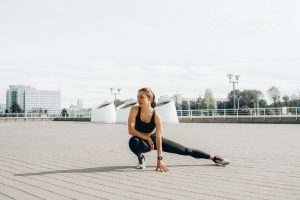
2. World’s Greatest Stretch (Full-Body Integration)
Why it matters: This single movement targets your spine, shoulders, hips, and hamstrings simultaneously. It’s the closest thing to a complete wake-up in one exercise.
- Starting position: Standing, feet hip-width apart. Step forward into a lunge with your right leg.
- Sequence: (1) Step right foot forward, drop into a lunge. (2) Place both hands on the ground inside your right foot. (3) Rotate your upper body to the right, reaching your right arm toward the ceiling. (4) Lower your arm, step your right foot back to plank position. (5) Return to standing. Repeat on the left side.
- Form cue: Keep your back knee just barely off the ground during the lunge. Your front knee should not pass your toes. During the rotation, feel a stretch through your entire spine, not just your chest.
- Repetition: 6 reps per side (12 total). Move continuously.
- Duration: 60 seconds. This is your most explosive movement.
- Rest: 0 seconds.
3. Leg Cradle (Hip Mobility)
Why it matters: Your hips are the second tightest joint in your body after your spine when you wake up. This stretch directly addresses hip internal rotation and anterior capsule tightness.
- Starting position: Standing on your left leg. Bring your right knee up toward your chest.
- Cradling technique: Cradle your right knee and shin in your hands, pulling it toward your chest and slightly toward your left shoulder. You should feel a deep stretch in your right hip.
- Form cue: Stand tall. Don’t lean backward. Keep your standing leg slightly bent for balance. If you need balance, touch a wall or counter.
- Duration: 30 seconds per leg (60 seconds total). Hold the stretch still—no bouncing.
- Breathing: Breathe deeply. Tension releases on the exhale.
- Rest: 0 seconds.
4. Knee Hug to Quad Activation (Hip Flexor + Glute Wake-Up)
Why it matters: Your hip flexors (iliopsoas) are often tight from sleeping in a flexed position. This stretch releases them while simultaneously activating your glutes.
- Starting position: Standing. Lift your right knee up and pull it toward your chest with both hands.
- Sequence: Hold the knee hug for 2 seconds, then release and stand tall. On the release, squeeze your glutes hard for 1 second. Repeat 10 times, then switch legs.
- Form cue: Pull your knee as high as it will comfortably go—don’t force it. The glute squeeze should be intentional, not casual. You’re “waking up” the glutes, not just releasing the hip flexors.
- Reps: 10 per leg (20 total). Dynamic movement, not a hold.
- Duration: 50 seconds total.
- Rest: 0 seconds.
5. Standing Quad Stretch (Anterior Chain Activation)
Why it matters: Your quads are tight from sleeping, and tight quads pull on your knees and lower back. This mobilizes them.
- Starting position: Standing on your left leg. Bend your right knee, bringing your right heel toward your glutes. Grab your right ankle with your right hand.
- Form cue: Don’t arch your lower back. Keep your pelvis neutral—imagine you’re wearing a belt and the belt stays level. Push your hips slightly forward, which increases the stretch without creating lower back strain.
- Duration: 30 seconds per leg (60 seconds total). This is a static hold, but only briefly.
- Breathing: Slow, deep breathing. Tension releases on exhales.
- Rest: 0 seconds.
6. Spinal Twist (Core + Digestive Activation)
Why it matters: Spinal rotations wake up your abdominal muscles, improve digestion, and release tension along the entire spine. This is one of the most overlooked morning stretches.
- Starting position: Standing. Bring your right knee up toward your chest while rotating your upper body to the right, bringing your left elbow toward your right knee.
- Form cue: Don’t force the rotation. Let it happen naturally as you bring your knee up. Keep your standing leg straight but not locked. Your upper back should rotate, not just your lower back.
- Reps: 10 per side (20 total). Move dynamically.
- Duration: 50 seconds total.
- Breathing: Inhale as you bring the knee up, exhale as you rotate.
- Rest: 0 seconds.
7. Inchworm Stretch (Hamstring + Shoulder Integration)
Why it matters: Inchworms activate your entire posterior chain (back of your body) while also engaging your shoulders and core. This is a compound movement that builds heat.
- Starting position: Standing, feet hip-width apart. Hinge forward at the hips and place your hands on the ground in front of your feet.
- Sequence: (1) Hands on ground. (2) Walk your hands forward into a plank position. (3) Keep your hips level. (4) Walk your hands back toward your feet. (5) Return to standing.
- Form cue: During the forward walk, your hips should not sag toward the ground. Engage your core. Your shoulders should be directly over your wrists in the plank position. Move slowly and deliberately.
- Reps: 8 reps. 1 rep = 1 forward walk + 1 return.
- Duration: 60 seconds (this is a high-intensity movement).
- Rest: 0 seconds.
8. Glute Bridge (Posterior Chain Activation + Glute Fire-Up)
Why it matters: The glute bridge is the grand finale. It activates your largest muscle group (glutes), extends your hips, and strengthens your lower back—all essential for proper posture after sleep.
- Starting position: Lying on your back. Knees bent, feet flat on the floor, hip-width apart. Arms at your sides with palms down.
- Execution: Press through your heels and lift your hips toward the ceiling, squeezing your glutes hard at the top. Lower back down without relaxing completely. Repeat.
- Form cue: Your knees should stay aligned with your ankles—don’t let them cave inward. At the top of the movement, your body should form a straight line from your knees to your shoulders. Squeeze your glutes intentionally at the top of each rep.
- Reps: 15 reps per set. 1 set.
- Duration: 50 seconds. Steady pace, no rush.
- Breathing: Exhale as you press up, inhale as you lower down.
- Rest: 0 seconds before moving on to your day.
Beginner to Advanced Progression Table
Not everyone’s body is the same. Here’s how to scale these 8 stretches based on your current fitness level. This progression table applies to the complete 8-stretch sequence (not individual exercises).
| Level | Duration Per Stretch | Movement Tempo | Total Routine Time | Frequency Per Week |
|---|---|---|---|---|
| Beginner | 30-40 seconds per stretch | Slow, controlled. Hold static stretches 30 sec. | 6-8 minutes | 3-4 days (allow recovery) |
| Intermediate | 45-60 seconds per stretch | Moderate. Add more reps to dynamic movements. | 7-9 minutes | 5-6 days per week |
| Advanced | 60-90 seconds per stretch | Fast, explosive. Full range of motion on inchworms. | 10-12 minutes | 6-7 days per week (daily) |
For beginners: Start with 3-4 days per week. Your muscles need recovery time as they adapt. If you feel sore the next day, take a day off. For intermediate: You can do this 5-6 days per week because you’re not adding significant load—you’re just moving. For advanced: This is suitable for daily use because dynamic stretching actually aids recovery rather than taxing the nervous system.
If you’re stiff, start as a beginner regardless of your fitness level. Stiffness is a mobility issue, not a strength issue, and pushing too hard too fast creates injury risk, not faster progress.
Your 5-Minute Morning Stretch Sequence (In Order)
Here’s your exact 5-minute routine. Do these stretches in this exact order. Each one prepares your body for the next one. Spend zero seconds thinking about what’s coming next—just move from one to another continuously. If you have better focus in the morning with comfy activewear, Yoga Trumpet Pants allow unrestricted movement through every stretch, especially during deep hip openers like leg cradles. Most people wear restrictive pajamas for morning stretching and wonder why they can’t access their full range of motion.
| Order | Exercise | Duration | Rest Between |
|---|---|---|---|
| 1 | Cat-Cow Stretch | 45 seconds | None |
| 2 | World’s Greatest Stretch | 60 seconds | None |
| 3 | Leg Cradle (both sides) | 60 seconds | None |
| 4 | Knee Hug to Quad Activation | 50 seconds | None |
| 5 | Standing Quad Stretch | 60 seconds | None |
| 6 | Spinal Twist (both sides) | 50 seconds | None |
| 7 | Inchworm Stretch | 60 seconds | None |
| 8 | Glute Bridge | 50 seconds | Complete rest after sequence |
Total time: 5 minutes 35 seconds for intermediate level. Beginners might take 6-7 minutes. Advanced trainees might finish in 5 minutes. Don’t worry about the exact timing—the point is consistency, not speed. Do this every morning, and your body will adapt faster than you expect.
Modifications for Common Problem Areas
Your body isn’t generic, so your morning stretches shouldn’t be either. Here are specific modifications for the most common problem areas I see with clients. If you have persistent pain in any of these areas, see a physical therapist before stretching aggressively.
Problem: Tight Lower Back
Root cause: Usually tight hip flexors and weak glutes pulling your pelvis out of alignment. The fix is not more lower back stretching—it’s better hip and glute activation.
- Modify the routine: Add 5 extra seconds to the glute bridge (hold at the top, squeeze hard). Add 10 extra seconds to the leg cradle. Skip aggressive spinal twists—replace them with cat-cow instead.
- Form adjustment: During world’s greatest stretch, lower your back knee to the ground fully and feel the hip flexor stretch. This directly addresses lower back pain’s root cause.
Problem: Tight Hips
Root cause: Sitting for 8+ hours daily, plus sleeping in a flexed position. Your hip external rotators need extra attention.
- Modify the routine: Hold leg cradle for 45 seconds per side instead of 30. Add a pigeon stretch after inchworm (lie on your back, cross right ankle over left knee, pull left knee toward your chest, 40 seconds per side). This directly targets hip mobility.
- Form adjustment: During all lunges (world’s greatest, inchworm), feel the stretch in the back leg’s hip. Go deeper into the lunge if you can.
Problem: Stiff Shoulders
Root cause: Poor posture while sitting or sleeping with arms overhead. Your upper back needs activation, not just stretching.
- Modify the routine: During cat-cow, really emphasize the cow phase—drop your chest toward the ground, look up, and feel your shoulder blades retract.
Get Free Weekly Workout Plans
Join Coach Alex every week for:
✅ Proven home workout plans ✅ Nutrition tips ✅ Gear reviews