⚡ Key Takeaways
📝 Table of Contents
- Sign #1: Your Current Workouts Feel Easy — Consistently
- Sign #2: You’ve Trained Consistently for at Least 8 Weeks
- Sign #3: You Recover Within 24–48 Hours
- Sign #4: You Understand Basic Movement Patterns
- Sign #5: You’re Mentally Bored, Not Just Physically Unchallenged
- #1. Adjustable Dumbbells — The Smarter Way to Progress at Home
- #2. Resistance Band Set — Best for Mobility + Strength Combos
- Frequently Asked Questions
- Our Pick
- Sign #1: Your Current Workouts Feel Easy — Consistently
- Sign #2: You’ve Trained Consistently for at Least 8 Weeks
- Sign #3: You Recover Within 24–48 Hours
- Sign #4: You Understand Basic Movement Patterns
- Sign #5: You’re Mentally Bored, Not Just Physically Unchallenged
Disclosure: This page may contain affiliate links. If you click and purchase, we may earn a small commission at no extra cost to you. See our Affiliate Disclosure for details.
💪 Free Fitness Tips — Straight to Your Inbox
Join thousands getting weekly workout guides, nutrition tips, and gear reviews. No spam, unsubscribe anytime.
Disclosure: As an Amazon Associate, we earn from qualifying purchases at no extra cost to you.
By the AuraFit Editorial Team · Last updated: October 2026 — Reviewed by our editorial team.
If you can complete 3 sets of 15 bodyweight squats with clean form and zero next-day dread, you’re likely ready for intermediate workouts — and the right equipment will make that jump stick. Most people stay in beginner mode 4–6 weeks longer than they need to, and that plateau is exactly what kills motivation. Here’s how to know you’ve genuinely crossed the line.
Last updated: June 2026
You’re ready for intermediate workouts when your current routine feels too easy, your recovery is fast, and your form is consistent — not just occasional. Pairing that readiness with adjustable dumbbells and a resistance band set gives you the most flexibility as your programming complexity grows.
Sign #1: Your Current Workouts Feel Easy — Consistently
One easy session doesn’t mean you’re ready. But if your last 3 weeks of workouts have felt manageable — you finish without real fatigue, your heart rate barely climbs, and you’re never sore the next day — your body is waving a green flag. According to the American Council on Exercise, the principle of progressive overload requires you to consistently increase challenge to continue making gains. Staying comfortable is the fastest road to stagnation.
Form cue to check first: Can you complete your exercises through a full range of motion, controlled on both the way up and the way down? If yes, you’ve earned the right to add load or complexity.
Beginner modification: If you’re not quite there yet, try adding a 2-second pause at the hardest point of each rep before jumping programs.
Sign #2: You’ve Trained Consistently for at Least 8 Weeks
Eight weeks is the minimum threshold most certified trainers use before recommending a program jump. That’s not arbitrary — it’s roughly how long it takes your connective tissue (tendons, ligaments) to catch up to your muscle strength. Your muscles adapt faster than your joints, which is exactly why rushing the timeline leads to injury, not progress. If you’ve hit 3 workouts per week for 8 consecutive weeks without a major break, your foundation is real.
Safety note: If you have any joint pain, chronic conditions, or are returning from an injury, consult your doctor before increasing intensity. The Mayo Clinic recommends a physician clearance before significantly changing exercise load.
Sign #3: You Recover Within 24–48 Hours
Early in training, soreness lasting 3–4 days after a session is normal. At the intermediate level, your body should bounce back within 48 hours on most days. Fast recovery isn’t just comfort — it’s a direct signal that your cardiovascular system, muscles, and nervous system have adapted to the current stress load and need a bigger challenge to keep improving.
Form cue: Track your resting heart rate in the morning. If it stays within 5 beats of your normal baseline the day after training, your recovery capacity is solid.
Sign #4: You Understand Basic Movement Patterns
Intermediate programs layer complexity on top of fundamentals. If you can execute a bodyweight squat, hip hinge, push-up, and row without thinking about it — meaning the cues are automatic — you’re ready to add external load and compound combinations. If you still have to mentally rehearse each cue mid-rep, spend another 2 weeks drilling the basics. No shame in that; it’s exactly what separates people who get results from people who get hurt.
Sign #5: You’re Mentally Bored, Not Just Physically Unchallenged
Mental engagement matters more than most trainers admit. Research shows that exercise adherence drops sharply when perceived exertion stays below a 5 out of 10 for more than 3 consecutive weeks. If you’re watching a full TV episode between sets and still finishing strong, your program isn’t keeping up with you. That boredom is data. Act on it.
#1. Adjustable Dumbbells — The Smarter Way to Progress at Home
Adjustable dumbbells are the single most versatile tool for intermediate home training. They let you apply progressive overload across dozens of exercises without buying an entire rack — most quality sets replace 15 pairs of fixed weights. Whether you’re moving into dumbbell presses, Romanian deadlifts, or goblet squats, having weights that scale from 5 to 50+ lbs in small increments is what makes intermediate programming actually work.
- ✅ Replaces up to 15 pairs of fixed dumbbells in one compact unit
- ✅ Fast 5-second weight change keeps workout intensity high
- ✅ Supports progressive overload across every major movement pattern
- ❌ Higher upfront cost than fixed dumbbells — expect to spend $150–$300 for a quality set
#2. Resistance Band Set — Best for Mobility + Strength Combos
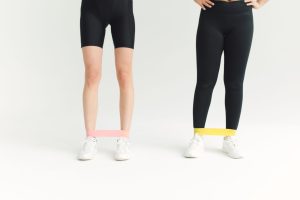
A quality resistance band set fills the gaps that dumbbells can’t. Bands keep constant tension through the full range of motion, which is especially useful for intermediate lifters targeting glutes, shoulders, and back. They’re also ideal on days when joint stress is high — bands load the muscle without compressing the joint. A set covering 10–150 lbs of resistance covers virtually every intermediate exercise in your program.
- ✅ Constant tension improves muscle activation compared to free weights alone
- ✅ Portable — full intermediate workout fits in a backpack
- ✅ Joint-friendly option for high-volume or recovery training days
- ❌ Bands can snap over time — replace any band that shows visible fraying immediately
Frequently Asked Questions
How long should I stay at the beginner level before moving to intermediate?
Most people need 8–12 weeks of consistent training — 3 or more sessions per week — before intermediate programming is appropriate. If you’ve been inconsistent, reset your clock from the last time you trained 3 weeks straight without a break.
Can I jump to intermediate workouts if I’m over 50?
Yes, but prioritize the 8-week consistency rule even more strictly — connective tissue recovery takes roughly 20–30% longer after 50. Get a physician clearance first, then progress loads by no more than 5–10% per week to protect joints.
What’s the biggest mistake people make when moving to intermediate training?
Jumping to an intermediate program while still using beginner form. Heavier loads and complex movements amplify any existing technique flaw — a slight knee cave in a bodyweight squat becomes a serious problem under 40 lbs. Film yourself from the side and front before you add load.
Our Pick
Adjustable dumbbells are the top tool for making the beginner-to-intermediate jump at home — they give you the progressive overload options that a fixed-weight setup simply can’t match. If you’ve hit all 5 signs above, grab a set, drop your first week’s volume by 20%, and commit to the next 8 weeks like your results depend on it. They do.
You Might Also Like


Coach Alex Turner
Fitness Writer & Content Creator
Coach Alex lost 34 lbs with a $30 ab roller and has spent 8 years helping 200+ people train at home. Every guide on AuraFitGuides comes from real training experience, not theory.
Coach Alex Turner
AuraFit Editorial Team
Alex covers home workouts, nutrition, and fitness gear. Every guide on AuraFitGuides is built around exercises you can actually do without a gym — practical, honest, and backed by published research.
Also from our team
You Might Also Like