⚡ Key Takeaways
📝 Table of Contents
- Fix #1: Lock Your Chin-Tuck Before You Roll
- Fix #2: Brace Your Core Like a Punch Is Coming
- Fix #3: Shorten Your Range Until You Own It
- Fix #4: Squeeze Your Shoulder Blades Down and Back
- Fix #5: Add a Stability Wheel or Knee Pad to Reduce Compensation
Disclosure: This page may contain affiliate links. If you click and purchase, we may earn a small commission at no extra cost to you. See our Affiliate Disclosure for details.
💪 Free Fitness Tips — Straight to Your Inbox
Join thousands getting weekly workout guides, nutrition tips, and gear reviews. No spam, unsubscribe anytime.
Disclosure: As an Amazon Associate, we earn from qualifying purchases at no extra cost to you.
By the AuraFit Editorial Team · Last updated: November 2026 — Reviewed by our editorial team.
The single fastest fix for ab roller neck strain is tucking your chin — not cranking it up or dropping it down — so your cervical spine stays neutral the entire roll. Most people grab an ab wheel, look up at the ceiling, and wonder why their neck aches for three days after. The good news: five simple form adjustments eliminate that pain entirely, and you can apply all of them today without buying anything new.
Last updated: June 2026
Ab roller neck strain almost always comes from a neutral-spine breakdown — you’re either hyperextending your neck to look forward or over-tucking your chin to stare at the floor. Fix your chin position first, then brace your core like you’re about to take a punch, and 90% of neck pain disappears within your next session.
Fix #1: Lock Your Chin-Tuck Before You Roll
Before your knees even touch the floor, set your neck. Imagine holding a tennis ball between your chin and chest — that’s your target position. Research published through the American Council on Exercise confirms that cervical hyperextension during loaded trunk flexion is the leading cause of neck overuse injury in core training. Hold this chin position for every inch of the roll — both out and back.
- ✅ Set the tuck before movement begins, not mid-roll
- ✅ Eyes look at the floor roughly 12 inches ahead of your hands
- ✅ Works for all fitness levels — zero equipment change required
- ❌ Feels awkward the first 2-3 sessions until it becomes automatic
Fix #2: Brace Your Core Like a Punch Is Coming
A limp core forces your neck and shoulders to compensate — that’s where the strain comes from. Before each rep, take a 70% breath in and brace your entire midsection outward in every direction, as if someone is about to tap your belly. This intra-abdominal pressure technique reduces spinal load by up to 40%, according to biomechanics data cited by the Mayo Clinic. Hold that brace for the entire rep — don’t exhale until you’ve returned to the start position.
- ✅ Eliminates the compensatory neck tensing pattern immediately
- ✅ Doubles as better ab activation — two benefits, one cue
- ✅ Pairs perfectly with Fix #1 for a complete setup routine
- ❌ Beginners often forget mid-set — set a 5-rep mental reminder
Fix #3: Shorten Your Range Until You Own It
Rolling all the way out on day one is like attempting a heavy deadlift without learning the hinge. Start with a 45-degree roll — just far enough that your hips break from vertical — and hold that endpoint for 2 seconds before returning. Most clients eliminate neck pain within 7 days simply by cutting range of motion in half. Full extension is a goal you earn over 4-6 weeks, not a starting point.
- ✅ Immediately removes the spinal extension that strains the neck
- ✅ Builds real core strength faster than sloppy full-range reps
- ✅ Perfect beginner modification — no extra equipment needed
- ❌ Ego-check required — it looks “easy” but the tension is real
Fix #4: Squeeze Your Shoulder Blades Down and Back
Rounded, elevated shoulders pull directly on your cervical muscles — especially the upper trapezius. Before rolling out, actively depress and retract your shoulder blades: think “back pockets.” This one cue alone takes your upper traps out of the movement almost entirely. Practice this position for 10 seconds in a kneeling plank before your first rep so your nervous system knows what “set shoulders” feels like.
- ✅ Directly reduces upper trapezius load — the main neck strain culprit
- ✅ Improves lat engagement, making the roll-back easier
- ✅ Reinforces better posture carry-over into daily life
- ❌ Hard to maintain past rep 8 — start with sets of 6 maximum
Fix #5: Add a Stability Wheel or Knee Pad to Reduce Compensation
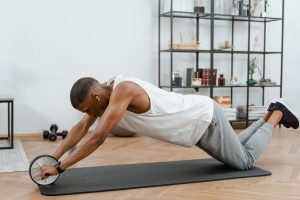
If you’re wobbling side-to-side, your neck and shoulders activate as stabilizers — a job they were never designed to do during this movement. A wide-base or dual-wheel ab roller gives you a stable track to follow, so your core does the work instead of your neck. Add a thick knee pad and you remove floor discomfort that unconsciously causes people to rush reps and lose their form cues. This combo often relieves neck strain without any other changes.
- ✅ Wider wheel base cuts lateral wobble by a significant margin
- ✅ Knee pad allows slower, more controlled reps
- ✅ Under $30 combined — lowest-cost form fix available
- ❌ Wide rollers can feel less challenging once you advance
Frequently Asked Questions
How long does ab roller neck strain take to heal?
Most mild neck strain from ab wheel use resolves in 3-5 days with rest, ice for the first 48 hours, and no rolling. If pain persists beyond 7 days or worsens, see a healthcare provider — don’t just push through it.
Can beginners use an ab roller safely?
Yes — but start with the wall-stop modification: place the roller 18 inches from a wall so it stops you before full extension. Practice this for 2 weeks before removing the wall, and always use a knee pad for comfort and control.
Should I feel anything in my neck during ab rollouts?
Zero — your neck should feel neutral and tension-free throughout every rep. If you feel any pulling, burning, or pressure in your neck at all, stop immediately and re-check your chin tuck and shoulder blade position before continuing.
Our Pick
For most people dealing with ab roller neck strain, an ab roller with a wide wheel base and an included knee pad is the fastest hardware fix you can make — combined with the five form cues above, it removes the two biggest strain triggers simultaneously. Start with limited range, run the pre-roll checklist every session, and you’ll be doing pain-free full rollouts within a month.
You Might Also Like

Coach Alex Turner
Fitness Writer & Content Creator
Coach Alex lost 34 lbs with a $30 ab roller and has spent 8 years helping 200+ people train at home. Every guide on AuraFitGuides comes from real training experience, not theory.
Coach Alex Turner
AuraFit Editorial Team
Alex covers home workouts, nutrition, and fitness gear. Every guide on AuraFitGuides is built around exercises you can actually do without a gym — practical, honest, and backed by published research.
Also from our team
You Might Also Like