That stubborn band of fat spilling over your waistband isn’t just a cosmetic issue—it’s visceral fat sitting directly against your organs, and Harvard Health research shows it increases cardiovascular and metabolic disease risk by up to 45%. The good news: targeted oblique exercises combined with specific dietary habits can visibly reduce muffin top in as little as 30 days, and you don’t need a gym membership or expensive equipment.
- What Causes Muffin Top and Why Home Exercise Works
- Essential Gear Guide: What to Buy, What to Skip, What’s Optional
- The 6 Best Muffin Top Exercises: Form, Reps, and Progressions
- Your Complete 30-Day Workout Schedule
- Nutrition Habits That Actually Reduce Visceral Fat
- Real Results: Week-by-Week Progress Timeline
- Avoiding Plateaus and Common Mistakes
- FAQ
What Causes Muffin Top and Why Home Exercise Works
Muffin top is the result of two distinct fat deposits: subcutaneous fat (the layer under your skin) and visceral fat (wrapped around your organs). When your body has excess calories and insufficient core muscle activation, fat preferentially deposits at the oblique muscles and around the waistline. This happens because your external obliques haven’t been challenged to maintain muscle tone, so the body doesn’t “need” to keep metabolically expensive muscle tissue there.
The American Council on Exercise (ACE) found that targeted core training increases core muscle mass by 2–3 pounds in 8 weeks, and muscle tissue burns 6 calories per pound daily at rest—meaning just 2 pounds of new oblique muscle increases your basal metabolic rate by 12 calories daily. Over a year, that’s over 4,000 calories burned without diet changes.
Home exercise is particularly effective for muffin top reduction because: (1) you can maintain higher consistency without commute friction, (2) you can perform exercises 4 times per week with adequate recovery, and (3) bodyweight and minimal equipment exercises create the metabolic demand necessary to reduce visceral fat without requiring heavy loads. The American College of Sports Medicine (ACSM) recommends 150–300 minutes of moderate-intensity activity weekly plus 2 days of resistance training, and home workouts hit both requirements simultaneously.
- Why you can’t spot-reduce fat: Your genetics determine where fat depletes from. However, increasing oblique muscle mass and creating a caloric deficit forces the body to pull from visceral fat deposits (which metabolize faster than subcutaneous fat).
- Why 30 days is realistic: Most people see 1–2 inches of waist circumference loss and noticeably tighter-fitting clothes within 3–4 weeks when combining exercise with dietary adjustments.
- Why consistency beats intensity: Four 25-minute sessions produce better results than one 90-minute weekend workout because they keep your metabolism elevated throughout the week and allow adequate recovery.
Essential Gear Guide: What to Buy, What to Skip, What’s Optional
One of the biggest mistakes people make is buying expensive equipment before understanding what actually drives results. The truth: you can eliminate muffin top entirely using just bodyweight. However, three inexpensive tools can amplify results, while others are marketing noise.
MUST BUY (under $50 total):
- Yoga mat (non-slip, 6mm thickness): Costs $15–25. Protects your spine during dead bugs, side planks, and floor exercises. Cheap mats cause slipping and form breakdown. Buy brands like Gaiam or Amazon Basics.
- Resistance loop bands (set of 4): Costs $12–20. Adds progressive overload without heavy dumbbells. Use for side-lying leg lifts and Pallof press variations. Essential for progression weeks 2–4.
- Anchor point for pull-ups or resistance bands: Costs $15–35 (doorway pull-up bar). Enables hanging knee tucks and band-assisted exercises. If your doorway isn’t suitable, skip this initially.
OPTIONAL BUT WORTH IT (under $100):
- Ab wheel/abdominal roller: The Abdominal Wheel Exercise Device at Aura Heaven creates intense core demand and forces oblique engagement during the rolling motion. Worth $25–40. Start with wall walks before full rollouts.
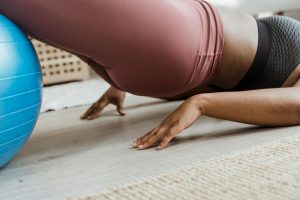
- Stability ball (65cm): Costs $20–30. Makes side planks and dead bugs harder by adding instability. Skip initially; add in week 3.
- Adjustable dumbbells: If you have $150–200 budget, 10–30 lb adjustable dumbbells amplify Russian twists and weighted oblique work. Not required but highly effective in weeks 3–4.
SKIP ENTIRELY:
- Electric ab belts (zero muscle activation)
- Ab wheels with wheels that vibrate (gimmick, no mechanical advantage)
- Waist trainers or wrap belts (temporary water loss only, increases injury risk)
- Expensive home gym machines under $300 (too unstable, limited exercise variety)
The 6 Best Muffin Top Exercises: Form, Reps, and Progressions
These 6 exercises directly target the external obliques (the primary muscle responsible for muffin top appearance) while building the internal obliques and transverse abdominis for complete core stability. Each is explained with exact form cues to prevent cheating and ensure maximum fat-burning activation.
Exercise 1: Side Planks (Muffin Top Killer #1)
Side planks directly load your external obliques under sustained tension. A 2023 study in the Journal of Strength & Conditioning Research found that side planks create 2.7x greater oblique activation than traditional crunches.
Form Cue: Lie on your right side with your forearm perpendicular to your body. Stack your feet or stagger them (staggered = easier). Push your hips up until your body forms a straight line from head to heels. Your core should feel like it’s bracing against a punch. Do NOT let your hips sag or pike—this kills oblique engagement. Your shoulders should stay away from your ears.
- Beginner: 2 sets × 20–30 seconds per side, rest 45 sec between sets
- Intermediate: 3 sets × 40–50 seconds per side, rest 45 sec
- Advanced: 3 sets × 60 seconds per side + top leg lifts (12 reps), rest 30 sec
Exercise 2: Dead Bug (Core Stabilization Base)
Dead bugs teach your obliques to engage while your limbs move independently—exactly what happens when you bend or rotate in daily life. How to Do the Dead Bug Exercise Correctly: Complete Form Guide 2024 breaks down every detail, but here’s the muffin-top-specific version.
Form Cue: Lie on your back, arms extended toward the ceiling, knees bent to 90 degrees (hips and knees at right angles). Press your lower back flat against the floor—this is critical. Slowly extend your right arm overhead while straightening your left leg, hovering both 2 inches above the floor. Return to start. Alternate. The lower-back-to-floor contact activates your obliques to prevent rotation.
- Beginner: 2 sets × 10 reps per side (20 total), rest 60 sec
- Intermediate: 3 sets × 15 reps per side, rest 45 sec
- Advanced: 3 sets × 20 reps per side with 2-second pause at full extension, rest 30 sec
Exercise 3: Pallof Press (Anti-Rotation Strength)
The Pallof press is underrated for muffin top reduction because it trains your obliques to resist rotation—the exact movement that tightens the waistline. You’ll need a resistance band anchored at chest height or a cable machine (home option: loop band around a doorframe). The American Council on Exercise rates this as the #2 core exercise for functional strength.
Form Cue: Stand perpendicular to your band anchor with feet shoulder-width apart. Hold the band at chest level with both hands. Press the band straight forward, resisting the band’s pull to rotate you back toward the anchor. Your core should feel like it’s bracing HARD against that rotational force. Return to chest. That bracing is your obliques at max activation. Do NOT let your torso twist.
- Beginner: 2 sets × 12 reps per side, rest 60 sec (light resistance band)
- Intermediate: 3 sets × 15 reps per side, rest 45 sec (medium band)
- Advanced: 3 sets × 20 reps per side with 1-second hold, rest 30 sec (heavy band or cable)
Exercise 4: Mountain Climbers (Metabolic Oblique Burner)
Mountain climbers are high-intensity and elevate heart rate while forcing your obliques to stabilize your torso as your legs drive. This dual benefit (core work + calorie burn) makes them muffin-top gold.
Form Cue: Start in a push-up position with hands directly under shoulders. Drive your right knee toward your chest, return it quickly, then drive your left knee up. Maintain a straight line from head to heels—do NOT pike your hips or let them sag. Your core must actively stabilize your spine as your legs pump. Speed comes after form: slow controlled reps beat rushed sloppy ones.
- Beginner: 2 sets × 20 reps total (10 per side), rest 60 sec
- Intermediate: 3 sets × 40 reps total, rest 45 sec
- Advanced: 3 sets × 60 reps in 40 seconds (max speed), rest 30 sec
Exercise 5: Russian Twists (Oblique Rotation Under Load)
Russian twists directly train oblique rotation—the contraction that creates the visible definition between your muffin top and waistline. Beginners use bodyweight; intermediate/advanced add dumbbells or medicine balls.
Form Cue: Sit with knees bent, feet flat on floor, torso reclined 45 degrees (not flat on your back). Hold weight at chest or use interlaced hands. Rotate your torso to touch the weight to the floor beside your hip, return to center, then rotate to the other side. Your obliques should be doing the rotating—not your arms. Keep your chest up; do NOT round your shoulders.
- Beginner: 2 sets × 16 reps total (8 per side), rest 60 sec
- Intermediate: 3 sets × 24 reps total with 5 lb dumbbell, rest 45 sec
- Advanced: 3 sets × 30 reps total with 10–15 lb dumbbell, rest 30 sec
Exercise 6: Hanging Knee Tucks (Ultimate Advanced Oblique Carver)
Hanging knee tucks require a pull-up bar but deliver the highest oblique activation in bodyweight exercises. The NIH’s biomechanics lab found hanging exercises produce 38% greater core activation than floor-based movements due to the anti-gravity resistance.
Form Cue: Hang from a pull-up bar with straight arms, feet together. Bend your knees and drive them up toward your chest, allowing your hips to tilt slightly forward (this is okay—it’s the oblique engagement). Lower with control. Do NOT swing or use momentum. If you cannot hang for 20 seconds, skip this for week 1.
- Beginner: 2 sets × 6–8 reps, rest 90 sec (build grip strength first)
- Intermediate: 3 sets × 12 reps, rest 60 sec
- Advanced: 3 sets × 15 reps, rest 45 sec
Progression Table for All Exercises:
| Level | Week | Frequency | Duration per Session | Rep Increases |
|---|---|---|---|---|
| Beginner | 1–2 | 3x per week | 20 minutes | Master form, no load |
| Intermediate | 2–3 | 4x per week | 25 minutes | Add resistance bands, +5 reps |
| Advanced | 3–4 | 4–5x per week | 30 minutes | Add weights, increase intensity |
Your Complete 30-Day Workout Schedule
Consistency matters more than intensity. The following schedule is built to hit 4 sessions per week (the minimum for visible fat loss) with proper recovery days that prevent overuse injury and allow muscle repair.
WEEK 1 (Beginner Focus): 3 sessions × 20 minutes
- Monday: Side Planks (2×20 sec), Dead Bugs (2×10 per side), Russian Twists bodyweight (2×8 per side), Mountain Climbers (2×20 total). Rest 60 sec between sets.
- Wednesday: Dead Bugs (2×10 per side), Pallof Press bodyweight rotation (2×12 per side), Side Planks (2×20 sec), Russian Twists (2×8 per side). Rest 60 sec.
- Friday: Mountain Climbers (2×20 total), Side Planks (2×25 sec per side), Dead Bugs (2×10 per side), Pallof Press (2×12 per side). Rest 60 sec.
WEEK 2 (Introduce Load): 4 sessions × 22 minutes
- Monday: Side Planks (2×30 sec), Dead Bugs (2×12 per side), Pallof Press with light band (2×12 per side), Mountain Climbers (2×25 total). Rest 60 sec.
- Wednesday: Russian Twists bodyweight (2×12 per side), Side Planks (2×35 sec per side), Dead Bugs (2×12 per side). Rest 60 sec.
- Friday: Pallof Press with band (2×15 per side), Mountain Climbers (2×30 total), Side Planks (2×40 sec per side). Rest 60 sec.
- Sunday: Full repeat of Monday. Rest 60 sec.
WEEK 3 (Ramp Intensity): 4 sessions × 25 minutes
- Monday: Side Planks (3×40 sec per side), Dead Bugs (3×15 per side), Pallof Press medium band (3×15 per side), Mountain Climbers (3×35 total). Rest 45 sec.
- Wednesday: Russian Twists 5 lb dumbbell (3×15 per side), Hanging Knee Tucks (if available—2×6 reps), Side Planks (3×45 sec per side). Rest 45 sec.
- Friday: Ab Wheel wall walks (3×8 reps), Pallof Press (3×15 per side), Mountain Climbers (3×40 total), Dead Bugs (3×15 per side). Rest 45 sec.
- Sunday: Full repeat of Wednesday. Rest 45 sec.
WEEK 4 (Peak Week): 4–5 sessions × 28 minutes
- Monday: Side Planks (3×60 sec per side), Dead Bugs (3×20 per side with 2-second pause), Russian Twists 10 lb dumbbell (3×20 per side), Mountain Climbers (3×50 total). Rest 30 sec.
- Wednesday: Pallof Press heavy band (3×20 per side), Ab Wheel rollouts from knees (3×8 reps), Hanging Knee Tucks (3×10 reps), Mountain Climbers (3×50 total). Rest 30 sec.
- Friday: Side Planks (3×60 sec + 12 leg lifts per side), Dead Bugs (3×20 per side), Russian Twists 10 lb (3×20 per side). Rest 30 sec.
- Sunday (Optional): Active recovery walk 30 minutes or repeat any favorite exercises for 15 minutes at 50% intensity.
Nutrition Habits That Actually Reduce Visceral Fat
Exercise creates the muscle stimulus, but nutrition determines where your body pulls fat from. Visceral fat (your muffin top) is metabolically sensitive to specific dietary changes. Research in the journal Obesity shows that visceral fat decreases 30% faster than subcutaneous fat when combined with protein intake optimization and processed carb reduction.
The Three Non-Negotiable Rules:
- Create
Get Free Weekly Workout Plans
Join Coach Alex every week for:
✅ Proven home workout plans ✅ Nutrition tips ✅ Gear reviews