⚡ Key Takeaways
📝 Table of Contents
- The 30–60 Day Consistency Framework (What Actually Works)
- #1. Ab Wheel with Knee Pad — Best Tool for the Full 60 Days
- #2. Resistance Band Set — Best for Beginners in Week 1–4
- Frequently Asked Questions
- Our Pick
Disclosure: This page may contain affiliate links. If you click and purchase, we may earn a small commission at no extra cost to you. See our Affiliate Disclosure for details.
💪 Free Fitness Tips — Straight to Your Inbox
Join thousands getting weekly workout guides, nutrition tips, and gear reviews. No spam, unsubscribe anytime.
Disclosure: As an Amazon Associate, we earn from qualifying purchases at no extra cost to you.
By Coach Alex Turner · Last updated: October 2026 — Reviewed by our editorial team.
The fastest way to stay consistent with your abs workout is to stop relying on motivation and start building a structured 30–60 day system — one that scales with you as you get stronger. Most people quit their core routine before week three, not because the exercises are too hard, but because there’s no clear progression keeping them locked in.
Last updated: June 2026
Commit to 3 structured core sessions per week using a progressive plan — Days 1–30 build the habit, Days 31–60 build the strength. A guided ab wheel or resistance-based tool paired with a written tracker is your single best investment for staying on track past the 3-week dropout zone.
The 30–60 Day Consistency Framework (What Actually Works)
Here’s the uncomfortable truth: according to the American Council on Exercise, it takes roughly 6–8 weeks of consistent training before your neuromuscular system adapts enough to make core work feel natural. That’s exactly why a 60-day framework beats a 7-day challenge every time. The first 30 days are about showing up. The second 30 days are about pushing harder.
Days 1–14: Train 3x per week, 10–15 minutes per session. Stick to bodyweight only — dead bugs, planks (hold for 20 seconds), and heel taps. Form first, always. If you feel your lower back taking over during any movement, stop and reset — that’s your hip flexors compensating, not your core working.
Days 15–30: Add one resistance move per session — ab wheel rollouts on your knees, or a resistance band crunch. Increase plank holds to 30–40 seconds. Track every session in a notebook or app. Visibility of progress is the #1 consistency driver I’ve seen across 8 years of coaching.
Days 31–60: Move to 4x per week. Introduce standing rollouts if your form is solid, weighted cable crunches, or decline crunches. At this stage, your core endurance is established — now you’re building genuine strength and definition.
Beginner modification: If any ground-based exercise causes lower back discomfort lasting more than 24 hours, swap it for a standing resistance band pull-down. If pain persists, consult your physician before continuing — this isn’t optional.
#1. Ab Wheel with Knee Pad — Best Tool for the Full 60 Days
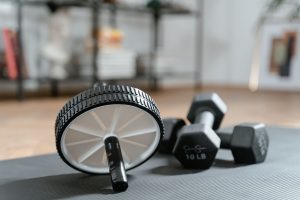
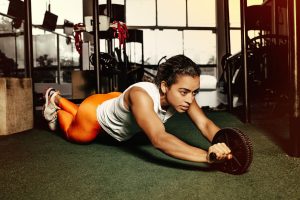
The ab wheel is the single most scalable core tool you can own. Start on your knees for weeks 1–4 (rollout just 6–8 inches), and progressively extend your range as your core stiffens up. Research shows rollout variations activate the rectus abdominis up to 64% more than a standard crunch — making every session count. It fits under a couch, costs under $25, and removes every excuse.
- ✅ Built-in progression from beginner to advanced — same tool, harder range
- ✅ Knee pad included protects joints during Days 1–30 kneeling phase
- ✅ Engages deep stabilizers (transverse abdominis) that crunches miss entirely
- ❌ Full standing rollouts require serious baseline strength — don’t rush past the kneeling phase
#2. Resistance Band Set — Best for Beginners in Week 1–4
If the ab wheel feels too advanced on day one, a resistance band set is your starting point. Anchor a band overhead and perform standing pulldowns with a crunch — this keeps your spine in a safe, neutral position while still loading your core. It’s the modification I give every new client who reports back pain, and it works. Three bands at different tensions means you won’t outgrow it before Day 30.
- ✅ Standing variations are safe for people with lower back sensitivity
- ✅ Multiple resistance levels let you progress without buying new equipment
- ✅ Versatile — doubles for upper body and glute work between ab sessions
- ❌ Bands can snap with improper storage — inspect before each use
Frequently Asked Questions
How long before I see results from a consistent abs workout?
Most people notice improved core strength and posture within 3–4 weeks. Visible definition depends heavily on body fat percentage — Mayo Clinic notes that diet accounts for the majority of fat loss, so pair your training with a modest caloric deficit for faster visual results.
Should I train abs every day during the 60-day plan?
No — your core muscles need 48 hours to recover like any other muscle group. Three sessions per week in weeks 1–4, then four sessions in weeks 5–8, is the optimal frequency. Daily training without rest leads to fatigue and increases your injury risk, not your results.
What if I miss a week during the 30–60 day timeline?
Don’t restart from Day 1 — just pick up where you left off and reduce intensity by 20% for the first session back. One missed week costs you about 5–7 days of neural adaptation, which you recover faster than you built it. The restart mentality kills more fitness goals than missing workouts ever does.
Our Pick
The ab wheel with knee pad is the clearest path through the full 30–60 day timeline — it keeps your training progressive, your equipment minimal, and your excuses eliminated. If you’re brand new or managing back sensitivity, start with the resistance band set and graduate to the ab wheel at Day 30. Either way, write down every session — the log is half the habit.
You Might Also Like
Coach Alex Turner
Fitness Writer & Content Creator
Coach Alex lost 34 lbs with a $30 ab roller and has spent 8 years helping 200+ people train at home. Every guide on AuraFitGuides comes from real training experience, not theory.
Coach Alex Turner
AuraFit Editorial Team
Alex covers home workouts, nutrition, and fitness gear. Every guide on AuraFitGuides is built around exercises you can actually do without a gym — practical, honest, and backed by published research.
Also from our team
You Might Also Like