⚡ Key Takeaways
📝 Table of Contents
- The 5 Science-Backed Steps to Start Exercising When You’re Out of Shape
- #1. Resistance Band Set — Best First Tool for Beginners
- #2. Fitness Tracker Watch — Best for Building the Walking Habit
- Frequently Asked Questions
- Our Pick
Disclosure: This page may contain affiliate links. If you click and purchase, we may earn a small commission at no extra cost to you. See our Affiliate Disclosure for details.
💪 Free Fitness Tips — Straight to Your Inbox
Join thousands getting weekly workout guides, nutrition tips, and gear reviews. No spam, unsubscribe anytime.
Disclosure: As an Amazon Associate, we earn from qualifying purchases at no extra cost to you.
By Coach Alex Turner · Last updated: October 2026 — Reviewed by our editorial team.
If you’re out of shape and wondering where to start, the answer is simpler than you think: begin with 10-minute walks three times a week, then build from there. Most beginners fail not because they lack willpower, but because they start too hard, too fast, and quit by week two. These five science-backed steps will keep that from happening to you.
Last updated: June 2026
Start with low-intensity movement for 10–20 minutes, 3 days a week, and add 10% more volume each week — no more. A resistance band set and a quality fitness tracker are the only two tools you actually need to get started safely at home.
The 5 Science-Backed Steps to Start Exercising When You’re Out of Shape
Step 1: Get a Medical Clearance First
Before a single squat, talk to your doctor if you’ve been sedentary for over a year, are over 45, or have any cardiovascular, joint, or metabolic condition. The Mayo Clinic recommends this step specifically for deconditioned adults — it’s not a formality, it’s how you avoid a setback that sidelines you for months. A 15-minute appointment can save you from a 6-week injury recovery.
Step 2: Start Absurdly Easy — Then Add 10% Per Week
The science is clear: overload drives adaptation, but too much overload too soon causes injury. The American Council on Exercise recommends the 10% rule — never increase your total weekly exercise volume by more than 10% from one week to the next. Week one looks like three 10-minute walks. Nothing more. That’s not laziness — that’s strategy.
Step 3: Build Around 3 Movement Types
Every effective beginner program hits three categories: cardio (walking, cycling), strength (bodyweight or resistance bands), and mobility (stretching, foam rolling). Aim for 2 cardio days, 1 strength day in week one. This triad approach prevents the muscle imbalances that cause 70% of beginner overuse injuries. You don’t need a gym — a resistance band set covers strength and mobility both.
Step 4: Nail Basic Form Before Adding Load
Form first, weight never. For bodyweight squats: feet shoulder-width apart, chest tall, knees tracking over your second toe, hips back like you’re sitting on a chair behind you. For push-ups, drop to your knees — that’s not a modification, that’s the beginner version. Never let your lower back arch or your neck crane forward. Perfect reps at zero weight teach your nervous system patterns that protect you for life.
Step 5: Track Consistency, Not Calories
Research from University College London found it takes an average of 66 days for a new behavior to become automatic — not the popular myth of 21 days. Your job in weeks one through four is to show up, not to crush it. A simple fitness tracker that logs your daily steps keeps you honest without obsession. Aim for 7,000 steps a day as your baseline target before worrying about anything else.
#1. Resistance Band Set — Best First Tool for Beginners
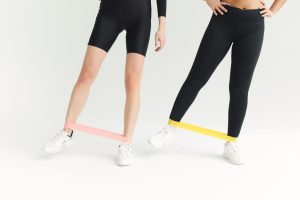
A quality resistance band set gives you scalable tension from 5 to 150+ lbs, meaning it grows with you from week one to year two. It’s the single piece of equipment I hand every new client on day one — no gym membership, no barbell, no problem. Studies show resistance training 2x per week increases strength by up to 30% in untrained adults within 8 weeks.
- ✅ Multiple resistance levels in one compact set — no swapping equipment mid-workout
- ✅ Zero joint impact compared to free weights — ideal for deconditioned joints
- ✅ Works every major muscle group: glutes, back, shoulders, chest, arms
- ❌ Bands can snap if stored improperly or overstretched beyond their rating
#2. Fitness Tracker Watch — Best for Building the Walking Habit
A fitness tracker turns abstract goals into daily visible data — and that feedback loop matters. Wearing one increases daily step counts by an average of 2,000 steps per day, according to a JAMA Internal Medicine meta-analysis. Look for heart rate monitoring, step tracking, and sleep data as your three non-negotiables. Everything else is noise for a beginner.
- ✅ Real-time heart rate keeps you in the safe beginner training zone (50–70% max HR)
- ✅ Sleep tracking reveals recovery gaps that explain low-energy workouts
- ✅ Step goal alerts create daily accountability without a trainer present
- ❌ Calorie burn estimates can be off by 20–30% — use them as relative, not absolute data
Frequently Asked Questions
How often should a complete beginner exercise per week?
Start with 3 days per week, never on consecutive days, to allow 48 hours of recovery between sessions. After 4 weeks of consistent attendance, you can add a fourth day if energy and soreness permit.
Is soreness after a workout normal for beginners?
Mild muscle soreness 24–48 hours after exercise — called DOMS — is normal and fades within 3 weeks as your body adapts. Sharp pain during exercise, or joint pain at any time, is not normal and means you should stop and consult a doctor.
Can I lose weight by just walking when I’m out of shape?
Yes — walking 7,000–10,000 steps daily creates a meaningful caloric deficit and improves insulin sensitivity within 2 weeks. Pair it with consistent sleep and modest dietary adjustments and walking alone produces measurable fat loss results for deconditioned beginners.
Our Pick
For anyone starting from zero, a resistance band set is the smartest first purchase you can make — it’s safe, scalable, and replaces an entire gym rack. Pair it with a fitness tracker to build the daily habit, and follow the 10% weekly progression rule, and you’ll be stronger in 8 weeks than you thought possible when you started.
You Might Also Like


Coach Alex Turner
Fitness Writer & Content Creator
Coach Alex lost 34 lbs with a $30 ab roller and has spent 8 years helping 200+ people train at home. Every guide on AuraFitGuides comes from real training experience, not theory.
Coach Alex Turner
AuraFit Editorial Team
Alex covers home workouts, nutrition, and fitness gear. Every guide on AuraFitGuides is built around exercises you can actually do without a gym — practical, honest, and backed by published research.
Also from our team
You Might Also Like