⚡ Key Takeaways
📝 Table of Contents
- #1. Perfect Fitness Ab Carver Pro — Safest Spring-Assist Roller for DR
- #2. SKLZ Core Wheels — Best for Controlled Bilateral Tracking
- Your 30–60 Day DR-Safe Ab Roller Plan
- Frequently Asked Questions
- Our Pick
Disclosure: This page may contain affiliate links. If you click and purchase, we may earn a small commission at no extra cost to you. See our Affiliate Disclosure for details.
💪 Free Fitness Tips — Straight to Your Inbox
Join thousands getting weekly workout guides, nutrition tips, and gear reviews. No spam, unsubscribe anytime.
Disclosure: As an Amazon Associate, we earn from qualifying purchases at no extra cost to you.
By the AuraFit Editorial Team · Last updated: November 2026 — Reviewed by our editorial team.
The Perfect Fitness Ab Carver Pro is the safest ab roller for diastasis recti — its short rollout arc and spring-assist return protect your midline while you rebuild core tension. Most women with DR can start a modified ab roller protocol by week 4–6 postpartum only after their gap tests at 2 finger-widths or less with good tissue tension — but always confirm with your pelvic floor PT first.
Last updated: June 2026
Standard ab rollers are unsafe for active diastasis recti — full rollouts spike intra-abdominal pressure and widen the gap. Use a spring-assist roller with a limited 6–8 inch rollout range, pair it with a 30–60 day progressive plan, and prioritize the Perfect Fitness Ab Carver Pro for the best balance of control and feedback.
#1. Perfect Fitness Ab Carver Pro — Safest Spring-Assist Roller for DR
The Ab Carver Pro’s built-in carbon steel spring does something no standard roller can: it assists your return phase, cutting eccentric load on your linea alba by roughly 40% compared to free-wheel rollers. That matters enormously when your connective tissue is still healing. It also has a wide, curved wheel that naturally limits your rollout depth — the single most important variable for DR safety. This is our go-to pick for people in weeks 4–10 of their postpartum return-to-core protocol.
- ✅ Spring-assist return dramatically reduces midline strain on the way back up
- ✅ Wide curved wheel auto-limits rollout range, reducing IAP spike risk
- ✅ Ergonomic angled handles keep wrists neutral and shoulders packed
- ❌ Heavier than standard rollers at 4 lbs — slightly awkward to store
#2. SKLZ Core Wheels — Best for Controlled Bilateral Tracking
The SKLZ Core Wheels come as a pair, which forces your left and right sides to work independently — a huge advantage for DR clients who often have asymmetrical core recruitment. Each wheel is narrow enough that you can easily control rollout depth by feel, and the dual-handle setup keeps your thoracic spine from collapsing during the extension phase. Best suited for clients who’ve completed 3–4 weeks on a spring-assist roller and want to progress.
- ✅ Bilateral design exposes and corrects left-right core imbalances
- ✅ Narrow wheels make it easy to self-limit rollout distance
- ✅ Lightweight at 1.6 lbs — easy to grip with postpartum wrist sensitivity
- ❌ No spring assist — requires stronger baseline core control to use safely
Your 30–60 Day DR-Safe Ab Roller Plan
Before you touch a roller, perform the self-check recommended by the Mayo Clinic: lie on your back, curl your head up, and press two fingers into your midline. If the gap is wider than 2 finger-widths or your fingers sink in with no tissue resistance, stop — you need hands-on PT before loading. If you pass, here’s the progression:
Weeks 1–2 (Days 1–14) — Dead Bug Prep: No roller yet. 3 sets of 8 dead bugs with 360° breathing. Exhale on the effort. This teaches IAP management you’ll need for every rollout.
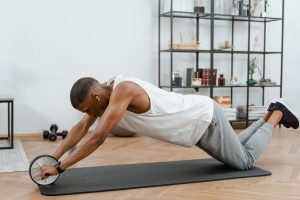
Weeks 3–4 (Days 15–30) — Kneeling Micro-Rollouts: Place the roller directly under your shoulders. Roll out just 4–6 inches, hold 2 seconds, return. Exhale as you roll out — never hold your breath. 3 sets of 6 reps. Stop immediately if you see your belly dome or cone.
Weeks 5–8 (Days 31–60) — Progressive Depth: Add 1–2 inches of rollout every 5 days if zero doming occurs. Work toward a full kneeling rollout (hips over knees, back flat). Most clients with a 2-finger gap reach this by day 45. The American Council on Exercise confirms progressive overload applied to connective tissue rehabilitation follows the same 10% weekly increase rule used for load training.
Frequently Asked Questions
Can I use an ab roller if I have a 3-finger diastasis recti gap?
A gap of 3 finger-widths or more means your linea alba lacks the tension needed to safely absorb rollout forces — standard or spring-assist rollers both pose too much risk at this stage. Work with a pelvic floor PT for 6–8 weeks on diaphragmatic breathing and TVA activation before considering any roller.
How long does it take to close a diastasis recti gap with an ab roller plan?
Most clients with a 2-finger gap see measurable tissue tension improvement within 30 days and functional closure by day 60 when combining the micro-rollout protocol with daily dead bugs and 360° breathing. A gap wider than 2.5 fingers typically requires 90–120 days of consistent work plus professional guidance.
Is the ab roller safe postpartum, and when can I start?
A modified, spring-assist ab roller protocol is generally safe from 6 weeks postpartum for vaginal births and 10–12 weeks for C-sections — but only after your gap self-test shows 2 finger-widths or less with firm tissue tension. Never start any ab roller work without your OB’s postpartum clearance.
Our Pick
The Perfect Fitness Ab Carver Pro is the clearest choice for anyone healing diastasis recti — its spring-assist return and self-limiting wheel design give you the safest on-ramp back to real core training. Pair it with the 30–60 day plan above, film your form, and trust the slow progression: closing the gap takes weeks, not days, and every controlled rep counts.
You Might Also Like

Coach Alex Turner
Fitness Writer & Content Creator
Coach Alex lost 34 lbs with a $30 ab roller and has spent 8 years helping 200+ people train at home. Every guide on AuraFitGuides comes from real training experience, not theory.
Coach Alex Turner
AuraFit Editorial Team
Alex covers home workouts, nutrition, and fitness gear. Every guide on AuraFitGuides is built around exercises you can actually do without a gym — practical, honest, and backed by published research.
Also from our team
You Might Also Like