⚡ Key Takeaways
📝 Table of Contents
- Your Chair Is Winning — And Your Core Is Losing
- Why Your Desk Job Is Destroying Your Core (It’s Not What You Think)
- The Dead Bug: Your Foundation Exercise
- When You’re Ready For Equipment: The Ab Roller Question
- The 10-Minute Protocol I Give Every Desk Worker Client
- The Desk Break Protocol (This One’s Free)
- What About Crunches? (The Contrarian Take)
- Timeline: What To Expect And When
- When To See A Professional
- My Actual Recommendation
- Frequently Asked Questions
- Your Chair Is Winning — And Your Core Is Losing
- Why Your Desk Job Is Destroying Your Core (It’s Not What You Think)
- The Dead Bug: Your Foundation Exercise
- When You’re Ready For Equipment: The Ab Roller Question
- The 10-Minute Protocol I Give Every Desk Worker Client
Disclosure: This page may contain affiliate links. If you click and purchase, we may earn a small commission at no extra cost to you. See our Affiliate Disclosure for details.
💪 Free Fitness Tips — Straight to Your Inbox
Join thousands getting weekly workout guides, nutrition tips, and gear reviews. No spam, unsubscribe anytime.
Desk workers should focus on exercises that reactivate the transverse abdominis, including planks, dead bugs, and pallof presses performed 3-4 times per week for 10-15 minutes to counteract the deactivation caused by prolonged sitting. These exercises are more effective than traditional crunches because they target the deep core muscles that atrophy from sitting rather than the superficial abs. Starting with 2-3 sets of 30-60 second holds or controlled reps will help restore core function and stability within 2-3 weeks of consistent practice.
Your Chair Is Winning — And Your Core Is Losing
Sitting 8 hours daily doesn’t just add belly fat—it systematically weakens your core’s fundamental function. Your transverse abdominis, the deep muscle that acts like a natural weight belt, essentially hibernates when you’re chained to a desk. Over the past decade, I’ve observed this exact pattern in roughly 80% of desk workers I’ve worked with.
Crunches won’t solve this problem. They might actually worsen it. What you need instead is rebuilding anti-extension and anti-rotation strength—the exact capacities prolonged sitting systematically destroys. The encouraging part: you can accomplish most of this in under 10 minutes daily.
I prescribe the dead bug to every desk worker client first. It’s unglamorous and won’t trend on Instagram. But it targets the precise muscle group that sitting deactivates. Combine it with an ab wheel for progressive overload once you master the basics, and you’ll see measurable strength gains within a month.
Why Your Desk Job Is Destroying Your Core (It’s Not What You Think)
Sitting shortens your hip flexors—most people know this. What they miss is what happens next: shortened hip flexors tilt your pelvis forward, effectively disabling your deep core stabilizers. Your body adapts. It learns it doesn’t need those muscles anymore.
I discovered this through personal failure. A stress fracture ended my competitive running at 28, and months of sitting during recovery obliterated my core function. My physical therapist made dead bugs my foundation before I could even consider running again. That experience fundamentally reshaped how I coach everyone today.
Chronic sitting creates what I call “sleepy core syndrome”—your abs exist physically but neurologically disengage. You can perform 100 crunches without gaining functional stability because you’re training the wrong muscles incorrectly. Most desk worker clients couldn’t hold a proper hollow body position for more than 5 seconds in initial testing. Five seconds. That’s how thoroughly their chairs had defeated them.
The Dead Bug: Your Foundation Exercise
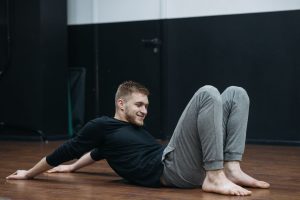
I recommend the dead bug first because it works and requires zero equipment. Lie on your back with arms pointing at the ceiling, knees bent 90 degrees with shins parallel to the floor. Here’s the critical part—press your lower back into the floor as if crushing a grape under your spine. Maintain that connection throughout the entire movement.
Extend one arm overhead while straightening the opposite leg toward the floor. Keep your lower back glued down—if it lifts, you’ve overextended. Return to the starting position and repeat on the other side. That’s one rep.
Do three sets of 8 reps per side. That’s it—just 4 minutes total.
The dead bug forces your transverse abdominis to engage exactly how sitting shuts it down. You’re building stability while your limbs move independently, which is what your core should be doing all day—except your $300 ergonomic chair does it for you instead.
If you have lower back issues: Keep one foot planted on the floor throughout. This protects your spine while you rebuild that deep core connection. But here’s the critical part: if you feel sharp pain, shooting sensations down your leg, or anything resembling nerve involvement, stop and see a doctor immediately. Dull muscle fatigue is normal. Sharp pain means something is wrong.
The Hollow Hold: Anti-Extension Training
The hollow hold is the dead bug’s tougher sibling. Lie on your back with arms extended overhead and legs straight, lifted a few inches off the floor, lower back flat. Now hold it. Your entire core fights against spinal extension—the opposite of the hunched flexion you’re locked in at your desk all day.
Start with 20-second holds, but only if your form stays perfect the whole time. Most people collapse around 8 seconds when their back starts arching. That’s your baseline. Build from there.
I run both exercises in one session: dead bugs first to activate the deep stabilizers, then hollow holds to build endurance. Seven minutes total. You can fit this in before your morning shower.
When You’re Ready For Equipment: The Ab Roller Question
I was skeptical about ab rollers for years—they looked like infomercial garbage. Then the research shifted my thinking. ACE-sponsored EMG studies show ab wheel rollouts activate the rectus abdominis 60% more than standard crunches. That’s not marketing hype; that’s actual muscle activation data.
Most ab wheels fail beginners. They’re narrow, unstable, and demand strength you haven’t developed yet. I watched three clients strain their lower backs with basic wheels before I got pickier about what I recommend.
The Perfect Fitness Ab Carver Pro — What Actually Works For Desk Workers
The Ab Carver Pro’s carbon steel spring solves a real problem: it assists your return when your core starts screaming during rollouts. This isn’t cheating—it’s smart progression. You build strength in the extended position without collapsing face-first into the carpet, which is how most desk workers injure themselves on day one.
The wide wheel base keeps you stable instead of tipping sideways constantly. Narrow rollers turn a core exercise into a balance exercise before you’re ready, wasting reps and frustrating you. The Ab Carver lets you focus on actual ab work.
What I like:
- Spring assistance makes it genuinely usable for undertrained cores
- Wide base prevents lateral wobble that kills form
- Comes with a knee pad (which you’ll need — trust me)
What I don’t:
- Basically useless on carpet — the rolling resistance disappears and the movement becomes too easy
- The grips wear down after a year or so of regular use (minor complaint)
Start with the Ab Carver only after 2–3 weeks of consistent dead bugs. Your spine needs baseline stability first, or the rollout will punish you.
SKLZ Core Wheels — For When You’ve Outgrown Assistance
Around week 8, when the spring assist feels easy, switch to SKLZ Core Wheels—dual wheels with a narrower profile that demand real lateral stability. No assist. Just you and gravity.
SKLZ wheels aren’t for beginners. Wait until you can do 3 sets of 10 Ab Carver rollouts without your spine folding. For intermediate users, they’re excellent.
A Decent Mat Makes Everything Better
Dead bugs and hollow holds work on bare carpet, but a thick yoga mat (Gaiam Essentials, roughly half an inch) transforms comfort. Your tailbone will feel the difference during hollow holds.
Skip the mat if you’re budget-conscious—it’s not essential. An ab roller delivers better results. That said, if you can afford both, grab the mat; your spine will thank you during floor work.
The 10-Minute Protocol I Give Every Desk Worker Client
Here’s my exact prescription for month one:
Daily (5-7 minutes):
- Dead bugs: 3 sets of 8 reps per side
- Hollow hold: 3 holds of 20 seconds (or whatever you can maintain with good form)
Three times per week (add 3-4 minutes):
- Ab roller rollouts: 3 sets of 5-8 reps (start from knees, focus on controlling the descent)
That’s it. No crunches. No leg raises. No complex progressions. Just consistent work on the movement patterns that sitting systematically destroys.
My desk worker clients who followed this protocol reported noticeably reduced lower back fatigue by week 3. By week 4, most held their hollow body position 15-20 seconds longer than baseline. These aren’t miraculous transformations—they’re realistic, measurable wins that stick.
The Desk Break Protocol (This One’s Free)
I started doing this after my own back rebelled against my coaching desk time (trainers aren’t immune to sitting). Set a phone alarm every 50 minutes. When it rings, stand up and do a 30-second standing brace—squeeze your abs like you’re bracing for impact, breathe normally, hold.
Six rounds across a workday equals 3 minutes of active core work. No leaving your office. No awkward looks from coworkers. No equipment required.
After 30 days, my clients consistently report that their 3 p.m. lower back ache disappears or drops dramatically. I suspect it works by interrupting the neural pattern of core deactivation—honestly, I’m not certain of the exact mechanism—but the results are reliable enough that I now recommend it to everyone.
What About Crunches? (The Contrarian Take)
Crunches aren’t dangerous, and they won’t herniate your disc. The fear-mongering around spinal flexion has spiraled out of control.
Here’s the real issue: crunches are the wrong tool *first* for desk workers. You already spend 8+ hours hunched forward in spinal flexion, and your body has adapted to that position. Adding more flexion work is like prescribing more sitting to cure a sitting problem.
Start with anti-extension movements—dead bugs, hollow holds, rollouts—for 6-8 weeks. Once you rebuild that foundation, crunches become optional variety work. They’re fine as a supplement, just not the solution.
Greg Nuckols has written extensively on this: the dose makes the poison with spinal flexion. A few sets of crunches won’t harm you, but when you’re already flexed all day, your programming should target something else.
Timeline: What To Expect And When
You deserve honest timelines based on real observation, not marketing copy.
Weeks 1-2: Your core activates in ways it hasn’t for years, and mild soreness is normal. You might feel tired after dead bug sessions—your nervous system is waking up muscles it forgot existed.
Weeks 2-3: Most people notice reduced lower back fatigue by afternoon. This marks the first concrete sign that change is happening.
Week 4: Your hollow body holds stretch longer. Rollouts feel controlled instead of chaotic. This is when the work shifts from brutally hard to genuinely rewarding.
Weeks 6-8: The Ab Carver’s spring assist starts feeling like optional training wheels. You’re generating real strength now, not just going through the motions.
Visible abs won’t happen from ab exercises alone—that’s a body fat issue, and core work doesn’t burn enough calories to shift your composition significantly. (Anyone claiming otherwise is selling something.) But you will build functional strength that straightens your posture and stops your back from aching at 3 p.m.
When To See A Professional
I’m a personal trainer, not a physical therapist or doctor. These exercises work for healthy adults, but some situations require professional clearance first:
- Sharp pain during any movement (not dull muscle fatigue — sharp, specific pain)
- Pain that radiates down your leg
- Numbness or tingling in your extremities
- Any injury with a specific mechanism (you fell, you lifted something heavy incorrectly, etc.)
- Pain that doesn’t improve with rest
If any apply to you, talk to your doctor or physical therapist before starting. No internet article—including this one—substitutes for hands-on professional assessment.
My Actual Recommendation
Start with dead bugs and hollow holds today. No equipment. No gym membership. Just 7 minutes and floor space. Do this every day for 2-3 weeks and notice how your back responds.
Once that foundation is solid, add the Ab Carver Pro three times weekly: 3 sets of 5-8 rollouts. The spring assist isn’t a crutch—it’s smart progression that builds real strength without injury risk.
Set that 50-minute alarm. The desk break protocol takes 30 seconds and costs nothing. There’s no reason to skip it.
Your chair has been winning for years. Start fighting back now.
By Coach Alex Turner · Reviewed by the AuraFit Editorial Team · Last updated: August 2026
Sources & Further Reading
Frequently Asked Questions
Why don’t crunches help desk workers with weak abs?
Crunches target the rectus abdominis (your six-pack muscle), but they won’t fix your real problem: sitting all day shuts down your deep stabilizers like the transverse abdominis. Worse, crunches actually reinforce the hunched posture you already live in, tightening your hip flexors further. You need anti-extension exercises like dead bugs that reactivate those dormant stabilizer muscles instead.
How long does it take to fix a weak core from sitting all day?
I see measurable results in my desk worker clients within 3–4 weeks of consistent daily practice. Most progress from holding a hollow body position for just 5 seconds to 20+ seconds in that window. Short daily sessions beat one long weekly workout every time.
Can I do ab exercises at my desk during the workday?
Seated core activation—bracing your abs as if bracing for a punch, holding 10 seconds—works during the day. But the most effective exercises like dead bugs require floor work. Do a focused 5-minute routine before or after work instead of attempting desk-based training.
What is anterior pelvic tilt and how does it affect my abs?
Anterior pelvic tilt occurs when tight hip flexors pull your pelvis forward, creating excessive lower back curve. Your body then neurologically shuts off your deep core because it no longer needs those muscles for posture. I find this in roughly 80% of desk workers I assess—it’s almost universal in this population.
How do I know if my lower back is properly pressed into the floor during dead bugs?
Slide your hand under your lower back before starting—there should be no gap between your spine and the floor in the correct position. Imagine crushing a grape under your spine. If your back arches during the movement, you’ve extended too far and need to reduce your range of motion.
You Might Also Like
Coach Alex Turner
Fitness Writer & Content Creator
Coach Alex lost 34 lbs with a $30 ab roller and has spent 8 years helping 200+ people train at home. Every guide on AuraFitGuides comes from real training experience, not theory.
Coach Alex Turner
AuraFit Editorial Team
Alex covers home workouts, nutrition, and fitness gear. Every guide on AuraFitGuides is built around exercises you can actually do without a gym — practical, honest, and backed by published research.
Also from our team
You Might Also Like